
USDA vs FHA Loans Texas: Which Is Better for Low Income Buyers?
You’re earning $60,000 a year, you’ve been saving diligently, and you’re ready to stop renting and buy a home in the DFW area — maybe Roanoke, Trophy Club, or somewhere in Tarrant County where you can actually picture your family settling down. You’ve heard that USDA and FHA loans are designed for buyers like you. Both offer low down payments. Both are government-backed. But when you start digging into the details, the confusion sets in fast. One requires zero down but has geographic restrictions. The other is available everywhere but comes with mortgage insurance that might never go away. Which one is actually better for your situation?
That confusion is completely valid — and it’s more common than you’d think. The honest answer is: it depends on where you’re buying, what you earn, and what your credit looks like. But “it depends” isn’t helpful without context. This guide breaks down every meaningful difference between USDA and FHA loans for low-income buyers in Texas, with specific numbers, real DFW examples, and clear guidance on which program makes more sense for different situations. By the end, you’ll know exactly where you stand — and what to do next.
Key Takeaways
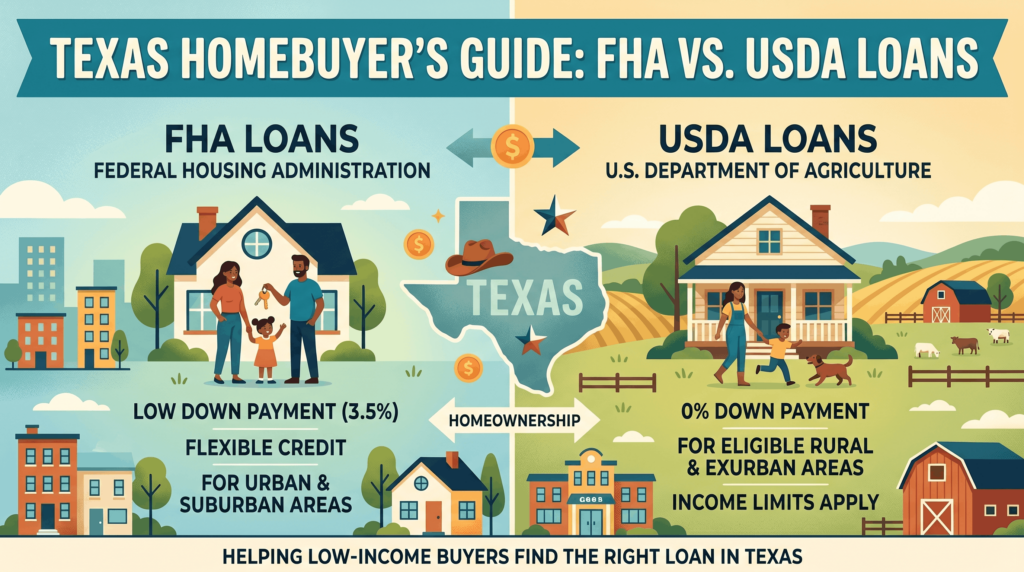
- USDA loans require 0% down payment — FHA requires 3.5%, which equals $8,750 on a $250,000 home in Tarrant County.
- USDA has strict geographic eligibility — many DFW suburbs like Grapevine and parts of Southlake no longer qualify due to population growth.
- USDA caps household income at 115% of AMI — roughly $95,000–$105,000 for a family of four in Tarrant County. FHA has no income ceiling.
- FHA mortgage insurance is effectively permanent for most low-income buyers who use the 3.5% down option (96.5% LTV).
- USDA’s annual fee (0.35%) is significantly lower than FHA’s annual MIP (0.55%–0.80%), saving $18,000–$36,000 over 30 years if eligible.
- For most DFW suburban buyers, FHA is the practical default — geographic restrictions eliminate USDA for the majority of properties in the metro area.
- Both programs allow Texas down payment assistance (TSAHC, TDHCA) to cover closing costs and reduce upfront cash needs.
- Pre-approval is the fastest way to confirm eligibility for either program — don’t spend weeks house hunting without it.
Understanding USDA and FHA Loans: The Basics
Before comparing these two programs head-to-head, it helps to understand why they exist and who they’re designed to serve. These aren’t interchangeable products — they come from different agencies, operate under different philosophies, and solve different problems for homebuyers.
USDA loan programs are administered by the U.S. Department of Agriculture through its Rural Development division. The USDA Single Family Housing Guaranteed Loan Program (SFHGLP) was created specifically to expand homeownership in rural and eligible suburban communities — areas that have historically had less access to affordable financing. The program works by having the USDA guarantee the loan made by an approved private lender, which reduces the lender’s risk and allows them to offer more favorable terms, including zero down payment.
FHA loans are insured by the Federal Housing Administration, which operates under the U.S. Department of Housing and Urban Development (HUD). Unlike USDA loans, FHA loans have no geographic restrictions and no income ceiling. They’re available to any buyer in any location who meets the credit, income, and property requirements — which makes them one of the most widely used mortgage programs in the country. Approximately 80–85% of FHA borrowers nationally are first-time homebuyers, according to NAR and CFPB data.
Both programs exist for the same fundamental reason: to help buyers who wouldn’t qualify for conventional financing access homeownership. Conventional loans typically require stronger credit, larger down payments, and stricter debt-to-income ratios. USDA and FHA fill that gap — but they do it in different ways, with different trade-offs. Understanding those trade-offs is the entire point of this guide.
The core difference isn’t just about eligibility requirements. It’s about how each program structures its costs, where you can buy, and what your long-term financial picture looks like. A buyer in Argyle or the outskirts of Keller might have a very different calculus than a buyer in Grapevine or Colleyville — and that’s exactly what we’re going to unpack.
Down Payment Requirements: The Biggest Advantage for Each Program
For most low-income buyers, the down payment is the single biggest obstacle to homeownership. Saving $10,000–$25,000 while paying rent, managing car payments, and handling everyday expenses is genuinely hard. Both USDA and FHA were designed with this reality in mind — but they approach it differently.
USDA loans require zero down payment. Not 1%. Not 2%. Zero. This is the program’s most powerful feature and the primary reason buyers in eligible areas gravitate toward it. You can purchase a home without having a single dollar saved for the down payment itself — though you’ll still need funds for closing costs unless those are covered separately.
FHA loans require a minimum of 3.5% down for borrowers with credit scores of 580 or higher. For borrowers with scores between 500 and 579, the requirement jumps to 10%. On a $250,000 home — a realistic entry-level price in many Tarrant County and Denton County neighborhoods — 3.5% equals $8,750. That’s real money for a buyer earning $55,000–$70,000 a year.
On a $300,000 home, the FHA down payment climbs to $10,500. These aren’t abstract numbers — they represent months or years of disciplined saving for many buyers in the DFW market.
Here’s the important nuance: both programs allow down payment assistance programs in Texas to be layered on top. Programs through the Texas State Affordable Housing Corporation (TSAHC) and the Texas Department of Housing and Community Affairs (TDHCA) can cover down payment and closing costs for qualifying buyers, making FHA’s 3.5% requirement much more manageable. Seller concessions — up to 6% of the purchase price — can also cover closing costs for both programs.
The 0% down advantage of USDA is real and significant — but it’s only available if the property is in a USDA-eligible area and you meet the income limits. For buyers whose target neighborhoods don’t qualify geographically, USDA’s down payment advantage is irrelevant. That’s the critical context we’ll explore in the next sections.
Income Limits: The Hidden Disqualifier for USDA Loans
This is where many buyers get tripped up — and it’s frustrating because it often doesn’t surface until late in the process. USDA loans are designed for low-to-moderate income buyers, which means they come with an income ceiling. If your household earns too much, you don’t qualify. Period.
USDA caps household income at 115% of the Area Median Income (AMI) for your specific county and family size. AMI is calculated annually by HUD and varies significantly by location. For a family of four in Tarrant County, the USDA income limit is approximately $95,000–$105,000 (based on 2025 USDA Rural Development data — confirm the current year’s exact figure on the USDA RD website before applying, as limits are recalculated annually).
This sounds generous — and for many buyers, it is. But here’s the catch: the income calculation includes all household members, not just the borrowers. If you’re a couple earning $45,000 each, your combined household income of $90,000 might still fall under the limit. But add a part-time working adult child or a spouse who recently got a raise, and you could find yourself just over the threshold.
FHA loans have no income ceiling. A teacher, nurse, mid-level manager, or first-time buyer earning $100,000 or more can still qualify for FHA financing. There is no maximum income — only minimum requirements for creditworthiness and ability to repay. This makes FHA accessible to a much broader range of buyers, including those who earn too much for USDA but don’t have the savings or credit profile for conventional financing.
The income limit issue is one of the most common reasons buyers discover mid-process that USDA isn’t available to them. They’ve already identified a property, gotten emotionally invested, and then learned during pre-approval that their household income exceeds the county limit. It’s a painful and avoidable situation.
⚠️ Warning: Don’t Fall in Love With a Property Before Confirming Eligibility
Many buyers spend weeks searching for USDA-eligible properties, only to discover during pre-approval that they’re over the income limit — or that the specific address they chose doesn’t appear on the USDA eligibility map. The USDA eligibility map tool at eligibility.sc.egov.usda.gov should be your first step, not your last. Income limits change annually, so confirm your specific county’s current-year limit before investing time in applications or property searches.
Not sure whether you fall under the USDA income limit or whether your target neighborhood is even eligible? A quick pre-approval conversation can answer both questions — and show you exactly what you can afford with either program.
Start Your Pre-ApprovalGeographic Eligibility: Why Many DFW Suburbs Don’t Qualify for USDA
This is the single most important factor for DFW buyers comparing USDA and FHA loans — and it’s the one that eliminates USDA as an option for the majority of buyers in the metro area. Understanding how USDA defines eligible areas isn’t just useful; it’s essential before you spend a single hour looking at properties.
USDA defines eligible areas as rural or suburban communities with populations under 35,000 that are not part of a larger urbanized area. The key phrase is “not part of a larger urbanized area” — because the DFW metro is one of the fastest-growing metropolitan areas in the country, and its urbanized boundary has expanded dramatically over the past decade.
Cities like Grapevine, Roanoke, Southlake, and Colleyville have grown rapidly and are now largely within the urbanized boundary of the DFW metro. Even if a neighborhood within these cities feels semi-rural — large lots, open land nearby, low traffic — the USDA eligibility map may classify it as ineligible based on its proximity to the broader metro’s urbanized core. A property that looks rural to the naked eye may still fail the USDA geographic test.
There are exceptions. Outlying areas of Argyle, parts of Keller, and some addresses on the fringes of Denton County may still qualify. But these are exceptions, not the rule — and you cannot assume eligibility based on how a neighborhood feels. The USDA eligibility map is the only authoritative source. Lenders cannot override it, and assumptions based on visual impressions are unreliable.
The USDA eligibility map is also updated periodically as population data changes. An area that was eligible two or three years ago may no longer be eligible today. This is why confirming eligibility for the specific address — not just the general area — is non-negotiable before proceeding with a USDA application.
FHA loan eligibility requirements include no such geographic restriction. FHA loans are available for properties in urban, suburban, and rural areas throughout Texas — as long as the property meets FHA’s Minimum Property Requirements (MPRs) for safety and structural soundness. A home in downtown Fort Worth, a suburb of Grapevine, or a rural property near Argyle can all qualify for FHA financing, provided the property passes the FHA appraisal.
This geographic flexibility is the primary reason FHA loans are the more practical choice for most DFW suburban buyers. When you’re shopping in Trophy Club, Colleyville, Southlake, or Roanoke, FHA gives you access to the full inventory of available homes. USDA may limit you to a small subset of properties — or eliminate the program entirely for your target area.
Monthly Costs Compared: Mortgage Insurance and Fees
Down payments and geographic eligibility get most of the attention, but the monthly cost comparison is where the long-term financial picture really takes shape. Both programs charge fees that function like mortgage insurance — protecting the lender if you default — but they structure those fees differently, and the difference adds up significantly over time.
USDA fees: The USDA charges an upfront guarantee fee of 1.00% of the loan amount, which can be financed into the loan (meaning you don’t need cash at closing to cover it). There’s also an annual fee of 0.35% of the outstanding loan balance, billed monthly. On a $250,000 loan, the upfront fee is $2,500 (financed) and the annual fee starts at approximately $73/month, decreasing slightly each year as the balance is paid down.
FHA fees: FHA charges an upfront mortgage insurance premium (UFMIP) of 1.75% of the base loan amount, also financeable. The annual MIP is 0.55% for most 30-year loans with an LTV above 90% — though it can range up to 0.80% depending on loan term and LTV. On a $250,000 loan with 3.5% down (loan amount of $241,250), the upfront MIP is $4,222 (financed) and the annual MIP starts at approximately $107/month.
Here’s how the full monthly payment comparison breaks down for a $250,000 home in Tarrant County, assuming a 30-year fixed rate at 6.5%, property taxes of approximately 1.8% annually, and homeowners insurance of $1,800/year:
| Cost Component | USDA (0% Down) | FHA (3.5% Down) |
|---|---|---|
| Principal & Interest | ~$1,580 | ~$1,527 |
| Annual Insurance/Guarantee Fee | ~$73 (0.35%) | ~$107 (0.55%) |
| Property Taxes (est.) | ~$375 | ~$375 |
| Homeowners Insurance (est.) | ~$150 | ~$150 |
| Estimated Monthly Total | ~$2,178 | ~$2,212 |
Note: These figures are illustrative estimates based on 2026 market conditions. Actual rates, taxes, and insurance will vary. Upfront fees are financed and reflected in the P&I amounts shown.
The monthly difference is approximately $34 — not dramatic on a month-to-month basis. But USDA’s lower annual fee creates meaningful savings over the life of the loan, which we’ll explore in the subsection below. For a $300,000 home, the USDA monthly estimate is approximately $2,583 versus FHA’s $2,624 — again, a modest monthly difference with significant long-term implications.
The Long-Term Cost Advantage: USDA vs. FHA Over 30 Years
The monthly difference of $34–$41 might seem minor, but compounded over 30 years, it becomes a substantial number. USDA’s annual fee of 0.35% versus FHA’s 0.55% represents a difference of 0.20 percentage points on the loan balance each year. On a $250,000 loan, that’s approximately $500/year — or $15,000 over 30 years in simple terms (and more when you account for the declining balance over time, the actual savings are closer to $12,000–$15,000 on a $250,000 loan).
For buyers who finance higher loan amounts — say $300,000 or more — the savings grow proportionally. Over 30 years, USDA borrowers can save approximately $18,000–$36,000 in insurance and guarantee fees compared to FHA borrowers, depending on loan size and exact fee rates.
There’s an important caveat here: FHA MIP can be removed — but only under specific conditions. If you originally put down 10% or more (LTV of 90% or less at origination), FHA MIP automatically cancels after 11 years. However, most low-income buyers use the 3.5% down option, which means their initial LTV is 96.5%. At that LTV, FHA MIP stays for the entire 30-year loan term unless you refinance into a conventional loan.
USDA’s annual fee also stays for the life of the loan, but because it’s lower to begin with, the long-term cost is still more favorable than FHA for eligible buyers. The bottom line: if you qualify for USDA and the property is eligible, the long-term cost advantage is real and meaningful.
⚠️ Warning: FHA Mortgage Insurance Doesn’t Go Away for Most Low-Income Buyers
FHA MIP is permanent if your initial loan-to-value (LTV) ratio is greater than 90%. With a 3.5% down payment, your LTV is 96.5% — meaning MIP stays for the entire 30-year loan term. You can only remove it by refinancing into a conventional loan, which requires approximately 20% equity and a qualifying credit profile.
This is a critical distinction that many lenders don’t emphasize upfront. If you’re planning to stay in your home long-term and can’t refinance in the near future, the lifetime cost of FHA MIP is a significant factor in your decision.
Want to see real numbers for your specific situation? Get a personalized cost comparison for USDA vs. FHA based on your income, credit score, and target home price in the DFW area.
Get a Personalized Cost ComparisonCredit Score Requirements: Which Program Is More Forgiving?
Credit score anxiety is real for many first-time buyers. If your score isn’t where you’d like it to be, you’re probably wondering which program gives you the best shot at approval. The official guidelines for both USDA and FHA are more flexible than conventional loans — but the reality on the ground is shaped by something called lender overlays, and that changes the picture considerably.
USDA has no official minimum credit score. The program allows for manual underwriting, which means a loan officer can evaluate your full financial picture rather than relying solely on an automated system. However, most lenders who offer USDA loans in Texas require a minimum score of 640 for automated approval through USDA’s Guaranteed Underwriting System (GUS). Below 640, you may still qualify through manual underwriting, but fewer lenders offer this path and the process is more rigorous.
FHA officially allows credit scores as low as 500 — with 10% down for scores between 500 and 579, and 3.5% down for scores of 580 and above. On paper, this makes FHA the more accessible program for buyers with damaged credit. In practice, most Texas lenders impose overlays that require a minimum score of 620 or even 640 for FHA loans, regardless of what HUD’s official guidelines say.
Lender overlays are stricter requirements that individual lenders impose on top of the official program minimums. They exist because lenders bear some risk even on government-backed loans, and they use overlays to manage that risk. The result is that the official minimum credit score for FHA (500) or USDA (none) is often irrelevant — what matters is what your specific lender will accept.
A buyer with a 600 credit score, for example, might find that most FHA lenders in the DFW area decline their application due to overlays, while a USDA lender willing to do manual underwriting might approve them. Conversely, a buyer with a 625 score might find FHA approval straightforward but USDA approval elusive because their target property isn’t geographically eligible.
Both programs are significantly more flexible with credit than conventional loan options, which typically require 620 or higher and have less flexibility for compensating factors. If your credit score is below 620, your best path forward is to speak directly with a lender about their specific requirements — not to assume the official program minimums apply.
💡 Tip: The Official Minimum Isn’t the Real Minimum
When researching credit score requirements, always ask your lender about their specific overlay requirements — not just the program’s official minimum. A lender who advertises “FHA loans available for scores as low as 580” may actually require 620 or higher in practice. The only way to know for certain is to speak with a licensed loan officer who can review your actual credit profile and tell you which programs you realistically qualify for today.
Debt-to-Income Ratio: How Much House Can You Actually Afford?
Your debt-to-income ratio (DTI) is one of the most important numbers in your mortgage application — and one of the least understood. DTI measures what percentage of your gross monthly income goes toward debt payments, including the proposed mortgage. Lenders use it to assess whether you can realistically handle the monthly payment without financial strain.
There are actually two DTI ratios that matter: the front-end ratio (housing costs only, as a percentage of gross income) and the back-end ratio (all monthly debt payments, including the mortgage, as a percentage of gross income). Most lenders focus primarily on the back-end ratio.
USDA guidelines typically target a housing ratio below 40% and a total debt ratio below 50%. However, USDA’s Guaranteed Underwriting System (GUS) provides significant flexibility — with strong compensating factors (excellent credit history, liquid reserves, stable employment history), GUS can approve DTI ratios up to 50% or occasionally higher. This makes USDA particularly useful for buyers who have student loans, car payments, or other recurring debts that push their DTI higher.
FHA standard guidelines target a 43% total DTI, with exceptions allowing up to 50% for borrowers with strong compensating factors — a high credit score, significant liquid reserves, minimal housing payment increase from current rent, or a history of stable income. FHA is also more flexible than conventional loans, which typically cap DTI at 43% with limited exceptions.
To put this in practical terms: a buyer earning $60,000 annually has a gross monthly income of $5,000. At a 43% DTI, their total monthly debt payments (including the new mortgage) can’t exceed $2,150. If they already have a $400/month car payment and $200/month in student loan payments, their maximum mortgage payment is approximately $1,550 — which translates to a home price of roughly $185,000–$200,000 depending on taxes and insurance.
USDA’s GUS system is often slightly more flexible for higher DTI ratios, which can be a meaningful advantage for buyers carrying student loans or multiple car payments. If you’re in this situation, it’s worth exploring both programs with a lender who can run your numbers through both systems. You can also explore the debt elimination strategies that can help improve your DTI before applying.
Property Requirements: What Homes Actually Qualify?
Beyond where a property is located, both programs have standards for the condition and quality of the homes they’ll finance. These requirements exist to protect buyers from purchasing homes with serious defects — but they also mean that not every home on the market will qualify for either program.
FHA Minimum Property Requirements (MPRs) are the more detailed and prescriptive of the two. FHA appraisers are trained to identify safety hazards, structural deficiencies, and systems that aren’t functioning properly. Common issues that can cause FHA appraisals to flag required repairs include: roofing with less than two years of remaining life, foundation problems, plumbing or electrical deficiencies, non-functioning heating systems, missing handrails on stairs, peeling paint (in homes built before 1978, due to lead paint concerns), and lack of working smoke detectors.
In the DFW market, older homes — particularly those built in the 1970s through early 1990s — are more likely to trigger FHA repair requirements. If you’re shopping in established neighborhoods of Grapevine, Keller, or Colleyville where homes from that era are common, be prepared for the possibility that an FHA appraisal might require repairs before the loan can close. These repairs can typically be negotiated with the seller, but they add time and complexity to the transaction.
USDA appraisals focus primarily on market value and geographic eligibility. While USDA does require properties to be in decent condition, the appraisal standards are generally less prescriptive than FHA’s. This can be an advantage when purchasing older homes in USDA-eligible areas — the appraisal is less likely to flag minor repair issues that would stop an FHA loan in its tracks.
Both programs allow seller concessions of up to 6% of the purchase price, which can be used to cover repair costs, closing expenses, or buydowns. If an FHA appraisal identifies required repairs, negotiating a seller concession to cover the cost is a common and effective strategy. You can also explore all available loan options if a property doesn’t meet the standards for either government-backed program.
Timeline and Processing: How Long Until You Close?
In a competitive DFW real estate market, closing timeline matters. Sellers favor buyers who can close quickly and reliably. Understanding the typical timeline for each program — and where delays are most likely to occur — helps you set realistic expectations and position your offer competitively.
USDA loans typically close in 45–60 days for straightforward applications. The additional time compared to conventional loans comes from several factors: property eligibility verification must be confirmed through the USDA system, the appraisal must be completed by a USDA-approved appraiser, and the loan file must go through USDA’s processing system before final approval. In some cases, USDA processing can add a week or two beyond what a standard FHA or conventional loan would require.
FHA loans typically close in 40–55 days for straightforward applications. FHA is one of the most widely used mortgage programs in Texas, which means most DFW lenders have deep experience with the process. More lenders, more experienced processors, and more competition generally translates to faster and more predictable timelines. The biggest wildcard for FHA is the appraisal — if the appraiser identifies required repairs, the timeline extends while those repairs are negotiated and completed.
USDA’s rural focus means that fewer lenders in the DFW area specialize in USDA loans. If you work with a lender who doesn’t process USDA loans regularly, the timeline can stretch further due to inexperience with the program’s specific requirements. Working with a lender who has established USDA processing experience is particularly important for keeping timelines on track.
For both programs, the most important timeline factor is having your documentation ready before you start the process: two years of tax returns, recent pay stubs, two months of bank statements, and employment verification. Buyers who have these ready at the start of the process consistently close faster than those who gather documents piecemeal. The team at Oasis Home Mortgages can walk you through exactly what you’ll need before you begin.
USDA vs FHA Loans in DFW: Which Program Wins for Low-Income Buyers?
After walking through every major comparison point, it’s time to synthesize the guidance into something actionable. Here’s the honest answer: for most DFW buyers, FHA is the more practical choice — but USDA is the better deal when you can use it. The geographic restriction is the deciding factor for the majority of buyers in this market.
“For most DFW suburban buyers, USDA’s zero-down advantage is irrelevant if the property isn’t eligible. FHA’s geographic flexibility makes it the default choice — but USDA is genuinely better for buyers who can access it.”
Choose FHA if:
- You’re buying in Grapevine, Roanoke, Southlake, Colleyville, Trophy Club, or any other established DFW suburb where USDA geographic eligibility is unlikely.
- Your household income exceeds 115% of the AMI for your county (approximately $95,000–$105,000 for a family of four in Tarrant County).
- You have access to Texas down payment assistance programs that can cover the 3.5% FHA requirement.
- You need faster processing and more lender options in the DFW market.
- You’re purchasing an older home that may have minor condition issues — USDA’s geographic ineligibility would be moot anyway.
Choose USDA if:
- You’ve confirmed the specific property address is USDA-eligible using the official USDA map tool.
- Your household income falls below the county’s 115% AMI threshold.
- You have zero down payment saved and don’t have access to DPA programs that would cover FHA’s 3.5%.
- You’re buying in outlying areas of Argyle, Keller, or rural Denton County where USDA eligibility is more likely.
- You want to minimize long-term mortgage insurance costs and plan to stay in the home for many years.
The geographic restriction eliminates USDA for roughly 80% of DFW buyers based on where they’re actually shopping. For those buyers, the choice isn’t really USDA vs. FHA — it’s FHA vs. conventional, and for low-income buyers without large down payments or perfect credit, FHA loan programs in Texas are almost always the stronger option.
It’s also worth noting that both programs are vastly better than conventional loans for low-income buyers without 20% down. The real question isn’t whether to use a government-backed program — it’s which one fits your specific situation. Don’t let the comparison between USDA and FHA distract you from the bigger picture: both programs exist to help buyers like you achieve homeownership, and either one can be the right answer depending on where you’re buying and what you qualify for.
💡 Tip: Get Pre-Approved Before You Start House Hunting
Pre-approval does more than confirm your borrowing capacity — it tells you which program you actually qualify for, based on your real credit score, income, and DTI. Many buyers spend weeks looking at USDA-eligible properties only to discover during pre-approval that they’re over the income limit or that their lender’s overlay requirements disqualify them.
A pre-approval letter also strengthens your offer in a competitive DFW market, where sellers routinely receive multiple bids. Buyers with pre-approval letters close faster and are taken more seriously by listing agents. Don’t skip this step — it’s the most valuable 30 minutes you’ll spend in the homebuying process.
If FHA sounds like the right fit for your DFW home purchase, the logical next step is a pre-approval to confirm your borrowing power, lock in your timeline, and start shopping with confidence.
Get Pre-Approved TodayComplete Side-by-Side Comparison: USDA vs FHA Loans in Texas
For buyers who want a quick reference, here’s the full comparison in one place. Use this table alongside the detailed sections above to make your decision:
| Feature | USDA Loan | FHA Loan |
|---|---|---|
| Down Payment | 0% | 3.5% (580+ FICO) |
| Income Limits | Yes — 115% AMI | None |
| Geographic Restrictions | Yes — rural/suburban only | None |
| Min. Credit Score | None (lender: 640+) | 500 (lender: 620+) |
| Upfront Fee | 1.00% (financeable) | 1.75% (financeable) |
| Annual Fee/MIP | 0.35% | 0.55%–0.80% |
| MIP Removal | No (stays for loan life) | Only if LTV ≤90% at start |
| Max DTI | Up to 50% (GUS) | Up to 50% (with factors) |
| Typical Close Time | 45–60 days | 40–55 days |
| Best For DFW Buyers | Outlying rural areas | Most DFW suburbs |
If you’re still unsure which row matters most for your situation, the ask a professional resource can connect you with a licensed loan officer who can review your specific numbers and give you a clear recommendation.
Frequently Asked Questions About USDA and FHA Loans in Texas
These are the questions we hear most often from DFW buyers comparing these two programs. If your question isn’t here, the mortgage glossary and our loan team are both available to help.
It depends entirely on the specific property address — not the city name. While Grapevine, Roanoke, and Southlake are growing suburbs, USDA eligibility is determined by population density and whether the address falls within an urbanized area boundary. Many developed neighborhoods within these cities are ineligible, but some outlying properties near the fringes may still qualify. You must check the USDA eligibility map at eligibility.sc.egov.usda.gov for the exact address before applying — assumptions based on the city name or how rural the area looks are unreliable and can lead to wasted time and disappointment.
Both USDA and FHA officially allow lower credit scores than conventional loans, but the reality is shaped by lender overlays. Most Texas lenders require 620 or higher for both programs, regardless of what the official guidelines say. USDA may offer slightly more flexibility through manual underwriting for scores between 600 and 640 — some lenders who specialize in USDA loans will work with scores in this range if compensating factors are strong. FHA lenders are more likely to decline scores below 620 outright due to overlay requirements. Your best path is to speak directly with a lender about their specific requirements rather than assuming the official minimums apply to your situation.
FHA mortgage insurance premium (MIP) is permanent for the life of the loan if your initial loan-to-value ratio is greater than 90%. With a 3.5% down payment, your LTV is 96.5% — which means MIP stays for the entire 30-year term with no automatic cancellation. The only way to remove FHA MIP is to refinance into a conventional loan once you’ve built sufficient equity (typically 20%) and qualify for conventional financing. If your initial LTV was 90% or less — meaning you put down 10% or more — MIP automatically cancels after 11 years. Most low-income buyers using the 3.5% option will carry MIP for the full loan term unless they refinance.
For a $250,000 home in Tarrant County, USDA costs approximately $2,178/month (0% down, 1.00% upfront guarantee fee financed in, 0.35% annual fee) while FHA costs approximately $2,212/month (3.5% down, 1.75% upfront MIP financed in, 0.55% annual MIP). The monthly difference is roughly $34 — not dramatic on a month-to-month basis, but USDA’s lower annual fee saves approximately $12,000–$15,000 over the full 30-year loan term. This advantage only applies if the property is USDA-eligible and you qualify on income; if either condition isn’t met, the comparison is moot and FHA becomes the only viable government-backed option.
Yes — many Texas down payment assistance programs, including those offered by TSAHC (Texas State Affordable Housing Corporation) and TDHCA (Texas Department of Housing and Community Affairs), are compatible with both USDA and FHA loans. These programs can cover down payment and closing costs, making homeownership significantly more accessible for buyers who qualify. The key is to confirm with your lender that the specific DPA program you’re considering supports your chosen loan type, as not every assistance program works with every loan product. A knowledgeable local lender can help you identify which combinations are available in your specific county and income range.
USDA income limits are set at 115% of the Area Median Income (AMI) and vary by family size and county. For a family of four in Tarrant County, the limit is approximately $95,000–$105,000 based on recent USDA Rural Development data — but the exact figure changes annually when USDA recalculates AMI thresholds, so you should always verify the current year’s limit directly on the USDA RD website before applying. Smaller households have lower limits, and larger households may have higher limits. If you’re close to the threshold, it’s worth checking whether any allowable deductions (such as childcare costs or medical expenses) can reduce your calculated household income for USDA qualification purposes.
Ready to Find Out Which Program Is Right for You?
Choosing between USDA and FHA isn’t something you should have to figure out alone — and the answer looks different for every buyer depending on where you’re buying, what you earn, and what your credit looks like. The good news is that you don’t have to guess.
The team at Oasis Home Mortgages works with first-time buyers throughout the DFW area — from Trophy Club and Roanoke to Keller, Argyle, and Colleyville — and we know this market. We can confirm USDA eligibility for specific addresses, run your numbers through both programs, and give you a clear, honest recommendation based on your actual situation.
There’s no pressure, no obligation, and no jargon. Just a straightforward conversation about your options and what they actually cost.
Start Your Pre-Approval — It’s FreeOasis Home Mortgages | 7 Greenbriar Ct, Trophy Club, TX 76262 | Serving DFW, Grapevine, Roanoke, Southlake, Colleyville, Keller, Argyle & surrounding communities

