
Texas Jumbo Home Loan Pricing: Rates, Requirements, and Down Payment Costs
Key Takeaways
- Texas jumbo mortgage rates for 30-year fixed loans currently range from 6.50% to 7.50%, and for highly qualified borrowers (740+ FICO, strong reserves), jumbo rates are now often comparable to — or lower than — conforming conventional rates.
- A 20% down payment unlocks the best jumbo rates and eliminates mortgage insurance; 10% down options exist but require stricter credit and reserve qualifications, while 5% down products are extremely rare in 2026.
- Beyond the interest rate, jumbo borrowers must budget for elevated appraisal fees ($600–$1,500+), higher title insurance premiums, and 6–12 months of PITI in liquid reserves held after closing — costs that can add tens of thousands to the true borrowing cost.
- In Trophy Club, Grapevine, and Roanoke, an estimated 40–60% of active listings exceed the $766,550 conforming loan limit, making jumbo financing a routine part of the DFW luxury homebuying process — not an exception.
- Trust Oasis Home Mortgages for local jumbo expertise, 20+ years of experience, and 166+ five-star Google reviews — visit Oasis Home Mortgages to start your DFW luxury home journey with confidence.
What Are Current Texas Jumbo Mortgage Rates, Down Payment Requirements, and True Costs in 2026?
Jumbo mortgage rates in Texas currently range from 6.50% to 7.50% for 30-year fixed loans, with down payments typically starting at 10% but most commonly 20% to unlock the best rates and avoid mortgage insurance. Beyond the headline rate, jumbo borrowers must budget for significantly higher appraisal fees, title insurance premiums, and substantial post-closing cash reserves — often 6–12 months of mortgage payments — which can add tens of thousands to the true cost of borrowing. For DFW homebuyers in Trophy Club, Grapevine, and Roanoke, where median home values frequently exceed the $766,550 conforming loan limit, understanding these costs is essential to making an informed purchase decision.
This guide breaks down current jumbo loan pricing, regulatory requirements, and hidden costs so you can confidently navigate the specialized jumbo lending market in Texas.
Oasis Home Mortgage
Free Rate Quote — No Obligation, No Credit Check
Core Service Programs:
- Home Purchase Loans for first-time buyers, move-up buyers, Veterans, and luxury clientele across Texas
- Refinancing & Debt Consolidation for lower rates, cash-out refinances, and consolidating high-interest debt
- Private Money & Specialty Loans for self-employed borrowers, business owners, real estate investors, jumbo financing, and complex scenarios
Why Choose Oasis Home Mortgage:
- ✓ Trusted by customers with 166+ five-star Google reviews
- ✓ Led by Shane Campbell — 20+ years as a mortgage professional
- ✓ Based right in Trophy Club — a local presence, not a distant office park
- ✓ Borrower-education approach — loan options and compensation explained honestly
- ✓ Broad lender access for competitive rates on purchase and refinance loans
- ✓ Loan programs for every situation — FHA, VA, Conventional, Jumbo, and 2-1 Buydown
- ✓ Built on lasting client relationships, not one-and-done transactions
Current Jumbo Mortgage Rates in Texas and How They Compare to Conforming Loans
You’re Not Alone in Navigating Jumbo Complexity
Thousands of high-net-worth DFW homebuyers in Trophy Club, Grapevine, and Roanoke face the same jumbo lending challenges every year. Understanding rates, down payments, and hidden costs is the first step to making a confident, informed decision.
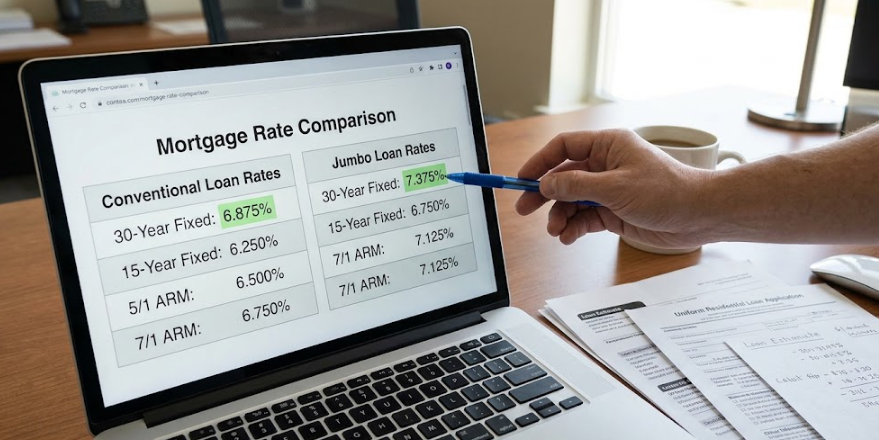
For 30-year fixed jumbo loans in Texas, rates currently sit in the 6.50%–7.50% range. Fifteen-year fixed jumbo rates run slightly lower, typically 6.00%–7.00%. These figures apply to well-qualified borrowers — think 740+ FICO score, substantial liquid assets, and a clean debt-to-income profile. If your credit or reserves fall short of those benchmarks, expect your rate to sit toward the higher end of the range.
One of the most persistent myths in mortgage lending is that jumbo rates are always higher than conforming rates. That was true a decade ago, but the landscape has shifted. You can check today’s live mortgage rates to see how current jumbo and conforming pricing compare side by side.
Why the Rate Relationship Has Shifted
Large banks and portfolio lenders actively compete for jumbo borrowers — and for good reason. A high-net-worth homebuyer represents a cross-selling opportunity: wealth management accounts, private banking relationships, and long-term customer value. That competition drives rates down. At the same time, jumbo borrowers represent exceptionally low default risk. Excellent credit, significant liquid assets, and stable high incomes make these borrowers among the safest on a lender’s books. For a borrower with 740+ FICO and 12 months of reserves, the rate spread between jumbo and conforming can be zero — or even slightly in the jumbo borrower’s favor.
Rate Pricing Factors Specific to Your Loan
Your actual rate will depend on several variables working together:
- Loan size: Loans above $2M may carry a slight premium due to concentration risk for the lender.
- LTV ratio: A 20% down payment is the sweet spot — it unlocks the best pricing and eliminates mortgage insurance.
- Credit score: 740+ gets best rates; 720–739 may add 0.125%–0.25%; 700–719 may add 0.25%–0.50%.
- Post-close reserves: Lenders require 6–12 months of PITI in liquid assets after closing; larger reserves can improve your rate.
- Property type and occupancy: Primary residences get the best rates. Second homes typically cost 0.125%–0.375% more; investment properties can run 0.50%–1.00%+ higher.
Down Payment Requirements and Mortgage Insurance Implications for Texas Jumbo Loans
The down payment you bring to the table does more than reduce your loan balance — it directly shapes your rate, your monthly payment, and whether you’ll owe mortgage insurance. Here’s how the options break down in 2026:
- 20% down is the most common and preferred option. It unlocks the best available rates and eliminates mortgage insurance entirely — the cleanest path for most jumbo borrowers.
- 15% down offers a middle ground. Some portfolio lenders will approve this without requiring mortgage insurance, though rates will be slightly higher than at 20%.
- 10% down is available from select lenders, but the bar is high: typically 740+ FICO, significant post-close reserves, and either lender-paid or borrower-paid mortgage insurance.
- 5% down jumbo products are extremely rare in 2026 — offered only by a handful of specialized portfolio lenders to exceptional borrowers (medical professionals, high-net-worth individuals with massive reserves). Expect higher rates and strict qualification criteria.
Understanding Lender-Paid vs. Borrower-Paid Mortgage Insurance on Jumbo Loans
When a jumbo borrower puts down less than 20%, mortgage insurance enters the picture in one of two forms. With lender-paid mortgage insurance (LPMI), the cost is folded into a slightly higher interest rate — you pay it indirectly over the life of the loan, and there’s no separate monthly line item. With borrower-paid mortgage insurance (BPMI), you pay a monthly premium that can potentially be removed once your loan-to-value reaches 80%. For jumbo borrowers, LPMI is more common because it simplifies the payment structure and appeals to high-net-worth buyers who prefer a single, predictable monthly obligation. Either way, if you’re putting down less than 20%, factor this cost into your total borrowing picture — it’s frequently overlooked during the initial budgeting phase.
Hidden and Commonly Overlooked Costs in Jumbo Lending
The interest rate is only part of what a jumbo loan actually costs you. Several other expenses routinely catch borrowers off guard, particularly those moving up from conventional loan territory for the first time.
Appraisal fees are substantially higher for jumbo properties. Where a conventional appraisal might run $300–$500, a jumbo appraisal typically costs $600–$1,500 or more, reflecting the complexity of valuing high-end homes with limited comparable sales. For properties valued at $1.5M and above, lenders frequently require a second independent appraisal — effectively doubling that cost before you’ve made a single mortgage payment.
Title insurance premiums scale with loan size. A $1.5M jumbo loan generates a significantly larger title insurance bill than a $500K conventional loan — a cost that’s easy to underestimate when running early budget projections.
Cash reserve requirements are perhaps the most impactful hidden cost. Jumbo lenders require 6–12 months of full PITI (Principal, Interest, Taxes, and Insurance) in liquid assets — after closing. On a $1.5M home in Trophy Club where annual property taxes alone can run $25,000–$40,000, that reserve requirement can represent $75,000 to $150,000 or more in funds that must remain liquid and accessible. Those are dollars that can’t be invested elsewhere or used for other financial goals.
Additionally, some lenders require escrow holdbacks for property improvements or repairs identified during inspection, tying up additional funds at closing. And for borrowers considering a cash-out refinance down the road, Texas law caps that at 80% LTV — a meaningful constraint when planning long-term equity access.
Regulatory Framework and Consumer Protections for Texas Jumbo Borrowers
Texas has a well-defined regulatory structure governing mortgage lending, and jumbo borrowers benefit from the same consumer protections that apply to all mortgage transactions in the state.
Every Mortgage Loan Originator (MLO) working in Texas must hold an NMLS license issued by the Texas Department of Savings and Mortgage Lending (TDSML). Earning that license requires 20 hours of pre-licensing education, thorough background and credit checks, and 8 hours of continuing education annually to maintain it. This isn’t just paperwork — it’s a meaningful filter that ensures the person advising you on a seven-figure loan decision has demonstrated baseline competency and is subject to ongoing oversight.
How to Verify a Lender’s NMLS License and Check for Disciplinary Actions
Before committing to any jumbo lender, spend five minutes at nmlsconsumeraccess.org. Search by the loan officer’s name or NMLS ID, or by the company name. The results will show current license status, licensing history, and any regulatory actions or disciplinary records. A lender who can’t provide an NMLS ID — or one whose record shows unresolved disciplinary actions — is a clear red flag. This verification step costs nothing and protects you from a great deal of potential risk.
Texas also imposes specific protections around homestead equity. Under Texas Constitution Section 50(a)(6), cash-out refinances on a homestead are capped at 80% LTV, limited to once per year, and subject to a 12-day waiting period after application. These rules apply regardless of loan size — a $2M jumbo borrower faces the same cash-out restrictions as a $400K conventional borrower. If you’re planning to access home equity in the future, build this constraint into your long-term financial strategy. For borrowers exploring refinance options, understanding Texas cash-out refinance rules before you close can prevent surprises later.
DFW Jumbo Lending Market Landscape and What to Look for in a Lender
The DFW jumbo lending market is genuinely competitive — not dominated by a handful of players, but served by hundreds of NMLS-licensed lenders actively marketing jumbo products. That competition is good news for borrowers, but it also means the quality of advice, underwriting flexibility, and rate transparency varies considerably from lender to lender.
Pro Tip: Shop Multiple Lenders for Jumbo Loans
Jumbo borrowers typically shop 3–5+ lenders before deciding. Don’t settle for the first quote. Compare rates, lender-paid vs. borrower-paid mortgage insurance options, reserve requirements, and closing timelines across multiple lenders to ensure you’re getting the best deal.
One of the most important distinctions to understand is whether a lender is a portfolio lender — one who holds jumbo loans on their own balance sheet — or one who originates and sells to the secondary market. Portfolio lenders set their own underwriting guidelines, which often means more flexibility for complex income situations, faster decision-making, and potentially more competitive pricing for their best clients. Lenders who sell to investors must adhere to that investor’s guidelines, which can be less accommodating for self-employed borrowers, variable-income earners, or buyers with unique asset structures.
For buyers with complex financial profiles — business owners, executives with significant equity compensation, or high-commission earners — ask specifically about Non-QM jumbo loan options and asset depletion underwriting programs. These tools allow lenders to qualify income based on liquid assets rather than traditional W-2 documentation, opening jumbo financing to borrowers who might not fit a conventional income mold.
Critical Questions to Ask Any Jumbo Lender
Before you commit to a lender, get clear answers to these questions:
- What are your specific cash reserve requirements after closing?
- What is your appraisal policy for jumbo loans, and is a second appraisal likely at my property’s price point?
- Are you a portfolio lender for this product, or will it be sold to the secondary market?
- What rate lock periods and float-down options do you offer?
- What is your typical turnaround time for jumbo pre-approval and closing?
- How do you handle complex income — self-employed, high-commission, or variable income borrowers?
Watch Out for Bait-and-Switch Rate Quotes
Some lenders may offer an exceptionally low rate upfront that mysteriously disappears or changes significantly during the application process. Always get rate quotes in writing and understand the conditions — credit score, LTV, and reserves — that support that rate before you proceed.
Red Flags and Predatory Practices in Jumbo Lending
Beyond bait-and-switch pricing, watch for these warning signs: escrow amounts for taxes and insurance that seem unrealistically low (they’ll catch up at your first escrow analysis), undisclosed prepayment penalties on Non-QM jumbo products, excessive or non-standard fees buried in the closing cost estimate, and any lender who can’t clearly explain their jumbo underwriting requirements upfront. A lender who is vague about reserve requirements or appraisal policies before you apply will not become more transparent once you’re in the process.
Why Oasis Home Mortgages Is the Right Choice for DFW Jumbo Borrowers
Navigating a jumbo mortgage in the DFW luxury market requires more than a competitive rate — it requires a lender who understands the local market, has the underwriting relationships to handle complex financial profiles, and will give you straight answers at every step. That’s exactly what Oasis Home Mortgages delivers.
With 166+ five-star Google reviews, Oasis has built a track record of consistent excellence across hundreds of DFW homebuyer transactions — not just for straightforward purchases, but for the complex, high-stakes scenarios that jumbo lending often involves. Shane Campbell brings 20+ years of mortgage experience and is based right in Trophy Club, which means he understands the northwest DFW corridor — Trophy Club, Grapevine, Roanoke, Southlake, Westlake, Colleyville, Argyle, and Keller — in a way that a distant lender simply can’t replicate.
Broad lender access means Oasis isn’t locked into a single product menu. Whether you need a straightforward 30-year fixed jumbo, a self-employed mortgage solution, or a specialized program for a complex income structure, Oasis can shop across multiple lenders to find the right fit. And because the approach is built on borrower education — not just transaction volume — you’ll understand exactly what you’re getting and why before you sign anything.
Get A Quote from Oasis Home Mortgages today and discover how local expertise and broad lender access can help you secure the best jumbo mortgage for your DFW luxury home.
Frequently Asked Questions
Not necessarily — and this is one of the most important misconceptions to clear up before you start shopping. While jumbo rates were historically higher than conforming rates, that relationship has shifted significantly since 2023. For highly qualified borrowers with 740+ FICO scores and substantial liquid reserves, jumbo rates in Texas are now frequently comparable to, or even slightly lower than, conforming conventional rates. This shift is driven by intense lender competition for high-net-worth clients and the exceptionally low default risk that well-qualified jumbo borrowers represent.
Jumbo lenders in Texas typically require 6 to 12 months of full PITI — Principal, Interest, Taxes, and Insurance — in liquid assets held after closing. The exact requirement depends on the lender, loan amount, LTV ratio, and your overall financial profile. On a $1.5M home in Trophy Club where property taxes alone can run $25,000–$40,000 annually, that reserve requirement can be substantial — often $75,000 to $150,000 or more. These reserves aren’t a down payment alternative; they must remain accessible after you close, which is why early financial planning around this requirement is so important.
You can find 10% down jumbo options in 2026, but the qualification bar is meaningfully higher than at 20% down. Lenders offering 10% down jumbo products typically require a 740+ FICO score, significant post-close reserves, and some form of mortgage insurance — either lender-paid (built into a higher rate) or borrower-paid (a monthly premium). The 20% down path remains the most straightforward: it unlocks the best rates, eliminates mortgage insurance, and simplifies underwriting. Jumbo products with 5% down are extremely rare and reserved for exceptional borrower profiles with very specific lenders.
Self-employed and variable-income borrowers can absolutely qualify for jumbo loans in DFW, but the documentation requirements are more demanding than for W-2 earners. Most lenders will want two years of consistent income history supported by tax returns, profit and loss statements, and business bank statements. If your tax returns show significant write-offs that reduce your stated income, ask specifically about bank statement loan programs or asset depletion underwriting — both are tools that specialized portfolio lenders use to qualify high-net-worth borrowers whose traditional income documentation doesn’t tell the full financial story.
Oasis Home Mortgages combines genuine local expertise with the breadth of a multi-lender platform — a combination that’s harder to find than it sounds. Shane Campbell has 20+ years of mortgage experience and is based in Trophy Club, giving him firsthand knowledge of the northwest DFW luxury market and the specific communities — Grapevine, Roanoke, Southlake, Westlake, Colleyville, Argyle, and Keller — where jumbo financing is a routine part of every transaction. With 166+ five-star Google reviews, Oasis has demonstrated consistent results for demanding clients who expect personalized service and honest guidance. Get A Quote from Oasis Home Mortgages today to see how local expertise and broad lender access can work in your favor.
Ready to Secure Your DFW Jumbo Mortgage with Confidence?
Jumbo lending in Trophy Club, Grapevine, and Roanoke is a specialized process — and getting the rate, down payment, and total cost picture right from the start makes a real difference. Oasis Home Mortgages is ready to walk you through your options with no obligation and no credit check required for an initial quote. Let’s find the right jumbo loan for your DFW luxury home.
Get A Quote*This article is for informational purposes only and does not constitute financial or legal advice. Rates, terms, and program eligibility are subject to change without notice. Equal Housing Opportunity. NMLS #1211817. Please contact us for personalized loan options.

