What Is A Mortgage Rate Lock: 30-60-90 Day Protection Strategies with Benefits
Key Takeaways
- A mortgage rate lock is a binding written agreement that holds your interest rate steady for 30, 60, or 90 days—protecting you from market increases between application and closing.
- Extended locks (60–90 days) are especially critical for DFW new construction in Trophy Club, Roanoke, and Grapevine, where builder timelines can stretch 6–12 months.
- On a $400,000 loan, a 0.25% rate increase from floating too long can cost $66 more per month—over $23,000 in additional interest across a 30-year term.
- Rate lock extension fees typically run 0.01%–0.03% per day of the loan amount; industry data shows 20–30% of closings experience delays that push past the initial lock period.
- Trust Oasis Home Mortgage for local DFW expertise, 166+ five-star Google reviews, and 20+ years of mortgage experience — visit Oasis Home Mortgage to start your home purchase with confidence.
What Is A Mortgage Rate Lock, and How Does It Protect Your DFW Home Purchase?
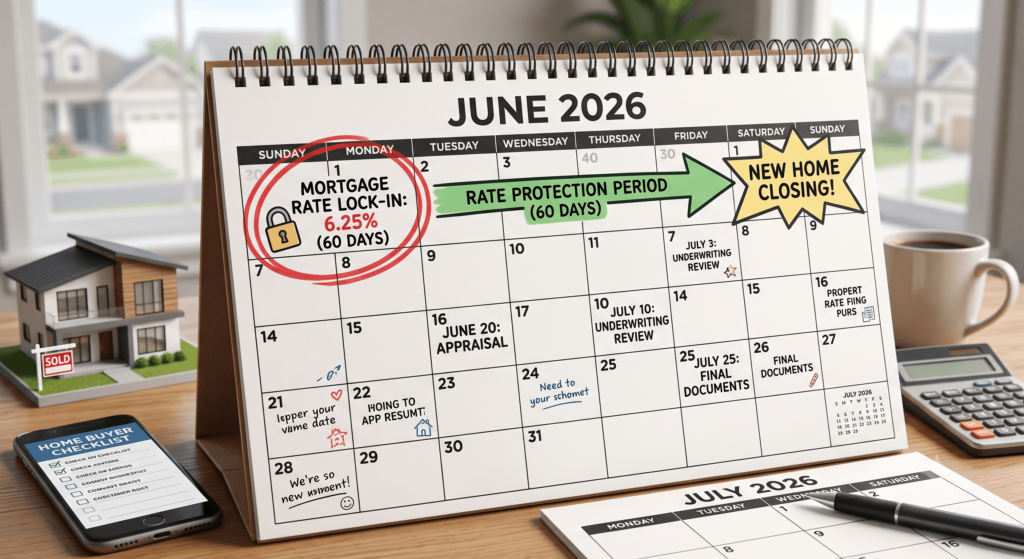
A mortgage rate lock is a lender’s written commitment to hold your interest rate steady for a specified period (typically 30, 60, or 90 days), protecting you from rate increases between loan application and closing. In the volatile DFW market, where rates can shift 0.25% or more within weeks, a rate lock can save you thousands of dollars over the life of your loan. Understanding lock duration, costs, and extension policies is essential for making an informed decision that aligns with your closing timeline and financial goals.
Let’s explore how rate locks work, what they cost in today’s market, and the strategic approaches DFW homebuyers use to maximize this protection.
Oasis Home Mortgage
Free Rate Quote — No Obligation, No Credit Check
Core Service Programs:
- Home Purchase Loans for first-time buyers, move-up buyers, Veterans, and luxury clientele across Texas
- Refinancing & Debt Consolidation for lower rates, cash-out refinances, and consolidating high-interest debt
- Private Money & Specialty Loans for self-employed borrowers, business owners, real estate investors, jumbo financing, and complex scenarios
Why Choose Oasis Home Mortgage:
- ✓ Trusted by customers with 166+ five-star Google reviews
- ✓ Led by Shane Campbell — 20+ years as a mortgage professional
- ✓ Based right in Trophy Club — a local presence, not a distant office park
- ✓ Borrower-education approach — loan options and compensation explained honestly
- ✓ Broad lender access for competitive rates on purchase and refinance loans
- ✓ Loan programs for every situation — FHA, VA, Conventional, Jumbo, and 2-1 Buydown
- ✓ Built on lasting client relationships, not one-and-done transactions
How Mortgage Rate Locks Work: The Basics
A rate lock is a binding written agreement between you and your lender that specifies three things: the exact interest rate being held, the number of days the lock is in effect, and the expiration date. Once that agreement is in place, the lender cannot raise your rate if market rates climb during the lock period—provided all loan conditions are met and you close within the specified timeframe.
The lock is documented in two places: your federally required Loan Estimate disclosure and a separate rate lock confirmation letter from your lender. Both documents must clearly state the locked rate, the duration, the expiration date, and any associated costs. If either document is vague on these points, ask for clarification before moving forward.
One important distinction: a rate lock does not guarantee loan approval. It only secures your rate, assuming underwriting conditions are satisfied and the property appraises at or above the purchase price. If your closing is delayed past the lock expiration, you’ll typically pay an extension fee to maintain the locked rate—or risk re-locking at whatever the market rate is that day.
You’re Not Alone in Worrying About Rate Locks
Many DFW homebuyers feel overwhelmed by rate lock decisions, especially in a volatile market. Understanding your options and asking the right questions is the first step to confidence.
Rate Lock Duration Options: 30, 60, 90 Days and Beyond
Choosing the right lock duration is one of the most consequential decisions in your mortgage process. The right answer depends entirely on your closing timeline—and in DFW, that timeline can vary dramatically depending on whether you’re buying an existing home or a new build.
30-day locks are the standard for existing home purchases with straightforward closings. They typically carry no explicit upfront cost; the lender absorbs the cost into the quoted interest rate. If your purchase agreement is signed and your closing is scheduled within a month, a 30-day lock is usually sufficient.
45-day locks add roughly 0.125% to 0.250% (1/8 to 1/4 point) to the loan amount, or 5–12.5 basis points to the interest rate. (A basis point is 0.01%, so 12.5 basis points equals 0.125%.) This buffer is useful when appraisals or underwriting reviews may take longer than expected.
60-day locks add 0.250% to 0.375% (1/4 to 3/8 point) and are popular for DFW purchases where title work, appraisals, or competitive market conditions may slow the process. 90-day locks add 0.375% to 0.50% (3/8 to 1/2 point) and are often essential for new construction in Trophy Club, Roanoke, and Grapevine, where builder timelines routinely extend beyond a standard closing window.
For new construction projects with timelines of six months or more, extended locks of 120–180+ days are available through specialized construction loan programs or builder-preferred lenders. These are sometimes offered at no explicit cost, but the expense is typically embedded in the home price or overall transaction terms. Reviewing your full range of loan options with an independent lender helps ensure you’re comparing apples to apples.
The True Cost of Rate Locks: Fees, Basis Points, and Extension Charges
Understanding what a rate lock actually costs—and where those costs can surprise you—is essential before you commit to any lock duration.
Watch Out for Hidden Extension Fees
Extension fees can quickly add $1,000+ to your closing costs if your closing is delayed. Always ask your lender upfront about their extension fee policy and calculate the cost before committing to a lock duration.
| Lock Duration | Typical Cost (Points) | Cost on $400K Loan | Best For |
|---|---|---|---|
| 30 Days | No explicit cost (absorbed into rate) | $0 upfront | Existing home, fast closing |
| 45 Days | 0.125%–0.250% | $500–$1,000 | Appraisal or underwriting buffer |
| 60 Days | 0.250%–0.375% | $1,000–$1,500 | DFW purchases with title or appraisal delays |
| 90 Days | 0.375%–0.500% | $1,500–$2,000 | New construction in Trophy Club, Roanoke, Grapevine |
| Extension (per week) | 0.05%–0.10% per week | $200–$400 per week | Closing delayed beyond lock expiration |
To put the ROI in concrete terms: on a $400,000 loan, paying $1,000 for a 90-day lock is often a smart trade. If rates rise 0.25% while you’re floating, your monthly payment increases by roughly $66—that’s $792 more per year and over $23,000 in additional interest across a 30-year term. The upfront lock cost pays for itself in under 16 months.
Float-down options—which let you capture a lower rate if the market drops before closing—are worth asking about, but they typically come with an upfront fee or a slightly higher initial locked rate. They’re most valuable if you have a genuine reason to believe rates will decline meaningfully before your closing date.
DFW Market Dynamics: Why Rate Locks Matter in Trophy Club, Grapevine, and Roanoke
The DFW metroplex isn’t a static market. Roanoke alone grew 17.5% between 2020 and 2023, and the broader metro added 34,900 net jobs in the 12 months ending September 2025. That kind of momentum creates persistent mortgage demand—and with it, the rate volatility that makes locking decisions consequential.
Pro Tip: Lock Early for New Construction in DFW
For new construction in Trophy Club, Grapevine, or Roanoke, lock your rate as soon as possible with an extended duration (60–90+ days) to cover the builder’s timeline and avoid multiple extensions at higher rates.
Master-planned communities across the northwest DFW corridor frequently have new construction timelines of 6–12+ months. For buyers in these communities, a standard 30-day lock is essentially useless—you need an extended lock from day one. As of June 2026, the DFW market sits at 4.1 months of supply, a balanced but active environment where homes averaged 80 days on market in Q1 2026. That’s up from 74 days in Q1 2025, which means processing timelines are stretching slightly—another reason to build cushion into your lock duration.
In affluent DFW suburbs like Trophy Club, where the median household income exceeds $170,000, a 0.25% rate increase translates to $60+ in additional monthly payment. Over 30 years, that’s a meaningful number. Buyers in these communities tend to be rate-sensitive and benefit from locking early with an experienced local lender who understands the builder landscape.
Builder-preferred lenders in DFW often advertise free extended locks or rate buy-downs as incentives. These can be genuine value—but they can also come with less flexibility and costs embedded elsewhere in the transaction. Comparing those offers against an independent lender’s terms, including checking today’s mortgage rates from multiple sources, is always worth the extra step.
Rate Lock Strategy: When to Lock, When to Float, and How to Decide
There’s no universal answer to when you should lock, but there is a clear framework for making the decision confidently.
Lock early if rates are stable or trending upward, if your closing timeline has any uncertainty, or if you’re buying new construction. Eliminating rate risk lets you focus on the rest of the transaction. Float only if rates are clearly trending downward, your closing date is certain and imminent, and you’re genuinely comfortable with the possibility that rates could reverse before you lock.
For most DFW buyers—especially those purchasing in active new construction corridors like Trophy Club or Roanoke—locking early with an extended duration is the lower-risk path. Industry data shows that 20–30% of mortgage closings experience some form of delay, often pushing past the initial lock period. Appraisal delays, underwriting conditions, title issues, and builder schedule changes are all common culprits in rapidly developing DFW suburbs.
A useful break-even calculation: if the cost difference between a 30-day and a 60-day lock is $500, and a 0.25% rate increase would cost you $792 per year, the extended lock pays for itself in under eight months. That math usually favors locking longer in an uncertain environment.
Whatever you decide, document it. Get the exact rate, duration, expiration date, extension fee policy, and any float-down terms in writing from your loan officer before the lock is confirmed. Verbal agreements are not enforceable—written confirmation is the only thing that protects you. If you want to explore how fixed-rate mortgage structures interact with your lock strategy, that’s a conversation worth having before you apply.
Regulatory Protections and Your Rights as a DFW Homebuyer
Rate lock agreements aren’t just a handshake—they’re legally binding, and the regulatory framework in Texas ensures you have real recourse if a lender fails to honor one.
Any lender offering mortgage rate locks in Texas must be licensed through the Nationwide Multistate Licensing System (NMLS) and overseen by the Texas Department of Savings and Mortgage Lending (SML). You can verify any lender’s license status and check for disciplinary actions at www.nmlsconsumeraccess.org. A clean record means no public complaints or enforcement actions on file.
Federal regulations under RESPA and TILA require lenders to disclose your rate lock terms clearly in the Loan Estimate—including the locked rate, duration, expiration date, and any associated costs. Once you receive a written rate lock confirmation, it’s a binding agreement. The lender cannot raise your rate if the market moves against you, and you cannot unilaterally cancel without penalty.
If a lender fails to honor a written rate lock commitment, you have three avenues for recourse: the Texas SML complaint process, the Consumer Financial Protection Bureau (CFPB), and potentially the Texas Deceptive Trade Practices Act (DTPA) if misrepresentation was involved. Texas also requires licensed mortgage companies to maintain surety bonds and professional liability insurance, providing a financial safety net for borrowers harmed by lender negligence or fraud.
The bottom line: always demand a written rate lock confirmation before proceeding. If a lender is evasive about extension fees, refuses to put lock terms in writing, or pressures you to lock before you’re ready, treat those as red flags. You can also ask a mortgage professional directly if you have questions about what your lock agreement should include.
Why Oasis Home Mortgage Is the Right Choice for DFW Homebuyers
Rate lock decisions aren’t made in a vacuum—they require a lender who understands your local market, your closing timeline, and your financial goals. That’s where Oasis Home Mortgage stands apart from the competition.
With 166+ five-star Google reviews and 20+ years of mortgage experience led by Shane Campbell, Oasis Home Mortgage has guided thousands of DFW homebuyers through exactly the kind of rate lock decisions this article covers. We’re not a distant call center—we’re locally based in Trophy Club, serving the northwest DFW corridor including Grapevine, Roanoke, Southlake, Westlake, Colleyville, Argyle, and Keller. We know the builder timelines, the seasonal demand patterns, and the appraisal quirks that affect your closing window.
Our broad lender access means we can shop competitive rates and flexible rate lock terms across multiple loan programs—whether you need a 30-day lock for an existing home purchase or a 90-day extended lock for a new construction project in a master-planned community. We work with first-time buyers, move-up buyers, luxury clients, and investors, tailoring our approach to your specific financial profile and risk tolerance.
Get A Quote from Oasis Home Mortgage and let our local expertise guide you through every step of your rate lock strategy and mortgage journey.
Frequently Asked Questions
If rates drop after you’ve locked, you’re generally committed to your locked rate—that’s the trade-off for being protected against increases. However, some lenders offer a float-down option, typically for an upfront fee or a slightly higher initial locked rate, that allows you to capture a lower market rate if it falls below your locked rate by a specified margin before closing. Without a float-down provision in your lock agreement, you cannot access the new lower rate. Ask your loan officer about float-down availability and cost before you lock, especially if market conditions suggest rates may ease.
Yes—once you receive a written rate lock commitment from your lender, it is a legally binding agreement for both parties. The lender is obligated to honor the locked rate, assuming all loan conditions are satisfied and the loan closes within the specified period. As the borrower, you are generally committed to that rate as well, barring a contractual float-down option or other provisions explicitly stated in the lock agreement. Federal disclosure requirements under RESPA and TILA ensure these terms must be clearly documented in your Loan Estimate and rate lock confirmation letter.
If you anticipate a closing delay, contact your loan officer immediately—don’t wait until the lock expires. Most lenders will extend your rate lock for a fee, typically calculated at 0.01% to 0.03% of the loan amount per day, or 0.05% to 0.10% per week. On a $400,000 loan, a one-week extension can cost $200 to $400; multiple extensions can add $1,000 or more to your closing costs. The best defense is choosing a lock duration that realistically covers your closing timeline from the start, and confirming your lender’s extension fee policy in writing before you lock.
Yes, builder-preferred lenders often structure their rate lock policies specifically around new construction timelines, sometimes offering free extended locks of 180+ days or rate buy-downs as incentives for using their services. These can be genuinely valuable—but the cost is frequently embedded in the home price, closing costs, or a less competitive interest rate. Independent lenders can shop a wider range of lock products across multiple programs, which may offer better overall terms even without the “free” lock incentive. Always get a competing quote from an independent lender before committing to a builder’s preferred lender.
Oasis Home Mortgage brings 20+ years of local expertise, 166+ five-star Google reviews, and a genuine understanding of DFW market dynamics—from new construction timelines in Trophy Club and Roanoke to seasonal demand patterns that affect closing windows across the metro. Shane Campbell and the Oasis team take a borrower-education approach: loan options and compensation are explained honestly, not buried in fine print. Our broad lender access means we can shop competitive rates and flexible rate lock terms across FHA, VA, Conventional, Jumbo, and specialty programs—tailored to your specific needs, whether you’re a first-time buyer or a seasoned investor. Get A Quote today and experience the Oasis difference.
Ready to Lock In Your Rate with a Trusted DFW Lender?
Rate lock decisions can mean thousands of dollars saved—or lost—over the life of your loan. Whether you’re buying an existing home in Grapevine, building in Trophy Club, or navigating new construction timelines in Roanoke, the right lock strategy starts with the right lender. Oasis Home Mortgage is locally based, deeply experienced, and ready to help you protect your rate with confidence.
Get A Quote*This article is for informational purposes only and does not constitute financial or legal advice. Rates, terms, and program eligibility are subject to change without notice. Equal Housing Opportunity. NMLS #1211817. Please contact us for personalized loan options.

