
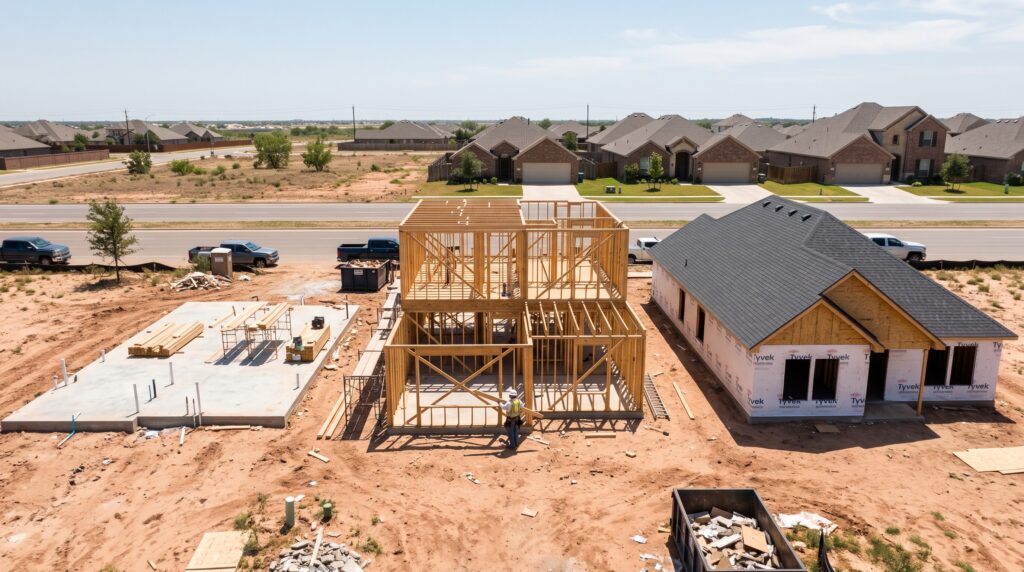
Construction Loan vs. Conventional Mortgage for Texas New Builds
Key Takeaways
- Construction loans fund the building process with variable interest rates (typically 8.0–11.0% during construction) and require 10–20%+ down, while conventional mortgages on completed new builds require as little as 3–5% down with a single closing and fixed rate from day one.
- A one-time-close (OTC) construction loan locks your permanent rate at the start, eliminating rate risk during the build—making it a strong middle-ground option for DFW buyers who want customization without full rate exposure.
- Construction delays of 1–3 months are common in North Texas post-COVID; a 60-day overrun on a $500,000 construction loan at 9% adds roughly $7,500 in interest alone, plus potential rent bridge costs.
- Builder incentives—rate buydowns and closing cost credits—have been widespread in DFW through 2024–2025, effectively lowering the true borrowing cost of new construction by 0.5–1.5% and making completed new builds more competitive than they appear at face value.
- Trust Oasis Home Mortgages for local DFW expertise, broad lender access, and 194+ five-star Google reviews — visit Oasis Home Mortgages to explore your new construction financing options.
Construction Loan vs. Conventional Mortgage for Texas New Builds: Which Is Right for You?
A construction loan finances the building process with variable interest rates during construction, then converts to a permanent mortgage—ideal if you want customization and early equity potential. A conventional mortgage on a completed new build offers simplicity, known pricing, and lower upfront costs—better if you prioritize certainty and speed. The choice depends on your timeline, budget flexibility, and appetite for managing construction risk.
Understanding the key differences in cost, timeline, and risk will help you decide which path aligns with your DFW home-buying goals.
Oasis Home Mortgage
Free Rate Quote — No Obligation, No Credit Check
Core Service Programs:
- Home Purchase Loans for first-time buyers, move-up buyers, Veterans, and luxury clientele across Texas
- Refinancing & Debt Consolidation for lower rates, cash-out refinances, and consolidating high-interest debt
- Private Money & Specialty Loans for self-employed borrowers, business owners, real estate investors, jumbo financing, and complex scenarios
Why Choose Oasis Home Mortgage:
- ✓ Trusted by customers with 194+ five-star Google reviews
- ✓ Led by Shane Campbell — 20+ years as a mortgage professional
- ✓ Based right in Trophy Club — a local presence, not a distant office park
- ✓ Borrower-education approach — loan options and compensation explained honestly
- ✓ Broad lender access for competitive rates on purchase and refinance loans
- ✓ Loan programs for every situation — FHA, VA, Conventional, Jumbo, and 2-1 Buydown
- ✓ Built on lasting client relationships, not one-and-done transactions
Construction Loans vs. Conventional Mortgages: Core Differences
These two financing paths serve fundamentally different purposes. A construction loan is a short-term, interest-only product that funds the building process in stages. A conventional mortgage is a long-term loan on a home that already exists—fully built, inspected, and appraised before you sign anything. The moment you decide to build versus buy completed, you’ve stepped into two very different risk profiles.
Construction Loan Structure
Construction loans operate in two phases. During the build phase, you pay interest only on the funds disbursed so far—not the full loan amount. The lender releases money in “draws” as construction milestones are verified by an inspector. This protects both parties: you’re not paying interest on money that hasn’t been spent, and the lender isn’t funding work that hasn’t been done. Once construction is complete, the loan either converts to a permanent mortgage (construction-to-permanent) or you close on a new loan entirely (two-time close).
Qualifying for a construction loan means underwriting both phases upfront. The lender evaluates your creditworthiness, the builder’s track record, the construction plans, and the projected completed value of the home. Down payment requirements are steeper—typically 10–20%, and often 15–25% for custom builds in the DFW market where lender overlays reflect higher project complexity.
Conventional Mortgage Structure
A conventional mortgage on a completed new build is structurally simple: one loan, one closing, one fixed rate. The home is appraised and inspected before you close, so there are no valuation surprises after the fact. You know your monthly payment on day one and can plan around it. For buyers purchasing a spec home or a recently completed builder home in Roanoke or Grapevine, this is the most straightforward path—and the one that most closely mirrors buying a resale home.
Conventional loans require as little as 3–5% down for owner-occupied primary residences under Fannie Mae and Freddie Mac guidelines. In the Trophy Club and Southlake price ranges ($700,000–$1,500,000+), many buyers will be looking at jumbo loan territory, which carries its own qualification standards but still benefits from the single-closing simplicity of conventional financing.
Cost Breakdown: Construction Loans vs. Conventional Mortgages in DFW
The cost gap between these two options is wider than most buyers expect. Beyond the interest rate difference, construction loans carry a layer of fees that compound quickly—especially if your build runs long.
Construction Loan Costs in Detail
Origination fees for construction loans run 0.5–2.0% of the loan amount, higher than the 0.5–1.5% typical for conventional mortgages. Each draw inspection costs $150–$300, and most builds require 8–12 draws—that’s up to $3,600 in inspection fees alone. Add draw processing fees of $50–$150 each, reserve requirements of 6–12 months of principal and interest held in escrow, and extended rate lock fees of 0.25–0.5% for one-time-close locks beyond six months. If you’re using a two-time-close structure, you’ll pay two full sets of closing costs—often $8,000–$15,000 combined on a DFW-sized loan.
Conventional Mortgage Costs
Conventional mortgages on completed homes carry standard closing costs of 2–5% of the loan amount, a single origination fee, and no inspection or draw fees. Total upfront cost typically lands between 2.5–6.5% of the purchase price. No reserve requirements beyond standard escrow. No rate lock extension fees. The cost structure is predictable from the start.
| Cost Factor | Construction Loan | Conventional Mortgage |
|---|---|---|
| Down Payment | 10–25%+ | 3–5% (conforming); 10–20% (jumbo) |
| Origination Fee | 0.5–2.0% | 0.5–1.5% |
| Draw/Inspection Fees | $1,600–$3,600+ (8–12 draws) | None |
| Closing Costs | $8,000–$15,000+ (two-time close); one set for OTC | 2–5% of loan amount (one closing) |
| Reserve Requirements | 6–12 months P&I in escrow | Standard escrow only |
| Rate Lock Extension Fee | 0.25–0.5% (OTC beyond 6 months) | None (30–60 day lock standard) |
| Total Upfront Cost (est.) | 15–30%+ of project cost | 2.5–6.5% of purchase price |
Interest Rates and Financing Terms: DFW Market 2026
Rate structure is where these two products diverge most sharply. During the construction phase, your rate is almost always variable—tied to the prime rate or SOFR plus a lender margin of 1–2%. In the current environment, that puts construction phase rates at roughly 8.0–11.0% for well-qualified borrowers. Conventional 30-year fixed rates for completed homes are running 6.5–7.5% for strong DFW borrowers in 2026, making the construction phase spread 1.5–4.0 percentage points higher.
That spread matters because you’re paying it for 6–18 months depending on your build timeline. On a $600,000 construction loan at 9.5%, your monthly interest-only payment is roughly $4,750. At a conventional 7.0% fixed rate on the same amount, your fully amortizing payment is around $3,993. The construction phase costs more every single month—and longer builds amplify that gap significantly.
One-time-close construction loans address this by locking your permanent rate at the beginning. You still pay the variable construction rate during the build, but your long-term mortgage rate is protected from market movement. For buyers in Trophy Club or Westlake planning custom builds that could stretch 12–18 months, this rate certainty is often worth the extended lock fee. Two-time-close loans leave your permanent rate exposed until conversion—a meaningful risk if rates move against you.
Builder Incentives Can Offset Higher Construction Rates
In 2024–2025, DFW builders aggressively offered rate buydowns and closing cost credits to attract buyers. These incentives can effectively lower your true borrowing cost by 0.5–1.5%, making new construction more competitive with resale homes even in a higher rate environment. If you’re buying a completed spec home, always ask what the builder’s preferred lender is offering—then compare it against an independent quote. A 2-1 buydown loan structure, for example, can reduce your rate meaningfully in the first two years while you settle in.
Timeline, Risk, and Hidden Costs of New Construction Financing
The risks embedded in construction loans are real, and they’re worth understanding before you commit. Standard single-family builds in North Texas average 6–12 months from groundbreaking to certificate of occupancy. Custom builds routinely run 9–18 months or longer. Post-COVID supply chain disruptions have eased somewhat, but overruns of 1–3 months remain common—especially for higher-end custom projects in Trophy Club and Colleyville.
Cost overruns are the borrower’s problem. If your builder’s materials costs increase or you approve change orders mid-build, you cover the difference—the lender won’t increase your loan to absorb it. Builder insolvency, while uncommon, is another exposure: if your builder goes out of business mid-project, the lender typically takes control of the project and finds a replacement contractor, leading to delays, cost increases, and legal complexity. Appraisal risk is a third factor—if the completed home appraises below the contracted price, you’ll need to cover the gap in cash, renegotiate with the builder, or walk away.
Construction Delays Are Real—and Expensive
If you’re worried about construction timelines, you’re right to be. Post-COVID overruns of 1–3 months (or more) are common, especially for custom builds. A 60-day delay on a $500,000 construction loan can cost $7,500+ in additional interest alone, plus rent bridge costs if you’re displaced. A 30-day delay at 9% on a $500,000 loan adds roughly $3,750 in interest, plus $1,800–$2,800 in additional DFW rent. A 90-day overrun can easily cost $10,000–$20,000 in combined carrying costs before you’ve moved in.
Conventional mortgages on completed homes eliminate virtually all of these risks. The home is built, the price is set, the appraisal is done before closing. You’re not exposed to construction timelines, cost overruns, or rate lock expiration. For buyers who value certainty over customization, this is a compelling advantage—particularly in a market where DFW new construction already offers modern finishes, energy efficiency, and builder warranties on spec homes.
Top Construction Lenders and Conventional Mortgage Providers in DFW: Compared and Reviewed
Construction lending in DFW is a specialty niche. While hundreds of NMLS-licensed lenders operate in the metro, true construction loan expertise is concentrated among local community banks, credit unions, and regional lenders who hold these loans in portfolio or have dedicated construction departments. National banks participate but often impose stricter underwriting overlays and higher loan minimums. Always verify any lender’s license at nmlsconsumeraccess.org before committing.
Always Compare Quotes—Don’t Default to the Builder’s Lender
While builder preferred lenders offer convenience and incentives, they may not offer the most competitive rates or terms. Research shows 60–80% of DFW new construction buyers end up using the builder’s preferred lender—often leaving money on the table. Get quotes from at least 2–3 lenders before committing, even if the builder’s lender seems attractive. The difference of 0.25% on a $700,000 loan is roughly $35,000 over 30 years.
Oasis Home Mortgages
Oasis Home Mortgages is locally based at 7 Greenbriar Ct, Trophy Club, TX 76262, serving the northwest DFW corridor including Grapevine, Roanoke, Southlake, Westlake, Colleyville, Argyle, and Keller. Founded by Shane Campbell, who brings 20+ years of mortgage experience, Oasis has earned 194+ five-star Google reviews from DFW homebuyers navigating both construction and conventional financing. Their broad lender access means you’re not locked into a single product shelf—whether you need a one-time-close construction loan, a conventional mortgage on a completed new build, or a jumbo product for a Trophy Club luxury home, Oasis can shop the market on your behalf.
Local Community Banks and Credit Unions
Community banks and credit unions are among the most active construction lenders in DFW, often holding loans in portfolio rather than selling them to the secondary market. This gives them flexibility to work with established local builders and borrowers with strong banking relationships. They typically offer competitive rates and personalized service, though some impose loan amount minimums or require prior builder relationships. If you have an established relationship with a local bank, it’s worth a conversation—but still compare the terms against an independent mortgage broker’s options.
Regional and National Lenders
Regional lenders offer standardized construction-to-permanent and one-time-close products with defined underwriting criteria—useful if you want a clear process with documented timelines. National banks participate in DFW construction lending but often bring stricter overlays: higher minimum loan amounts, more conservative appraisal requirements, and less flexibility on builder approval. For conventional mortgages on completed homes, national and online lenders are highly competitive on rate, though they may lack the local market knowledge that matters when an appraisal comes in short or a builder’s timeline slips.
| Lender Type | Construction Loans | Conventional Mortgages | Best For |
|---|---|---|---|
| Oasis Home Mortgages (Trophy Club) | Yes — broad lender access, OTC and C-to-Perm | Yes — competitive rates, all loan types | DFW buyers wanting local expertise and rate shopping |
| Local Community Banks / Credit Unions | Strong — portfolio lending, flexible underwriting | Yes — competitive for members | Established local builder relationships |
| Regional Lenders | Yes — standardized OTC and C-to-Perm products | Yes — broad product range | Buyers wanting defined processes and product variety |
| National / Online Lenders | Limited — stricter overlays, higher minimums | Yes — highly competitive on rate | Conventional mortgages on completed homes |
| Builder Preferred Lenders | Yes — streamlined for that builder’s process | Yes — with builder incentives attached | Buyers who qualify for and prioritize builder incentives |
Why Oasis Home Mortgages Is the Right Choice for DFW New Construction Borrowers
Navigating construction loan vs. conventional mortgage decisions in the DFW market requires more than a rate sheet—it requires someone who understands how Trophy Club appraisals work, which Roanoke builders have strong track records, and how to structure a loan that protects you if a build runs long. That’s the kind of local knowledge Oasis Home Mortgages brings to every transaction.
With 194+ five-star Google reviews, Oasis has earned the trust of hundreds of DFW homebuyers across the full spectrum of new construction financing—from first-time buyers in Roanoke targeting the $450,000–$550,000 range, to luxury home builders in Trophy Club financing $1,200,000+ custom builds. Shane Campbell’s 20+ years of mortgage experience means you’re working with someone who has seen rate cycles, builder delays, and appraisal gaps—and knows how to navigate them on your behalf.
Oasis’s broad lender access is a practical advantage: you’re not limited to one lender’s construction products or conventional offerings. Whether the right answer is a one-time-close construction loan, a fixed-rate mortgage on a completed spec home, or a VA or FHA construction product for an eligible borrower, Oasis can compare options across multiple lenders and match you to the financing that fits your situation—not the one that’s easiest to sell.
Frequently Asked Questions
Yes, both VA loans and FHA loans can finance new construction in Texas, typically through one-time-close construction-to-permanent products. However, the builder must be approved by the VA or FHA, and construction plans must meet their specific property requirements and inspection standards. The process is more complex than conventional financing—builder approval alone can add weeks to your timeline. If you’re a veteran considering new construction, comparing VA and conventional options side by side is worth the effort given the potential savings.
If the appraisal is lower than the agreed purchase price, the lender will only finance based on the appraised value—not what you contracted to pay. You’ll need to cover the difference in cash, renegotiate the price with the builder, or potentially walk away from the deal. This risk is particularly acute with construction loans, where the appraisal is based on projected completed value rather than an existing structure. In a market like DFW where new construction pricing can move quickly, getting an independent appraisal opinion before signing a builder contract is a smart protective step.
During the construction phase, rates are almost always variable, tied to the prime rate or SOFR plus a lender margin of 1–2%. Your interest-only payments will fluctuate as the benchmark rate moves. In the current environment, that puts construction phase rates at 8.0–11.0% for qualified DFW borrowers. For one-time-close construction loans, your permanent mortgage rate is locked at the beginning of the process, protecting you from rate increases during the build—though you still pay the variable rate during construction itself.
A one-time-close (OTC) construction loan is a single loan that covers both the construction phase and the permanent mortgage, with one closing and one set of closing costs. Your permanent rate is locked at the start, so you’re protected if rates rise during your build. You’d choose it over a two-time-close structure to save $8,000–$15,000 in duplicate closing costs and to eliminate the rate risk that comes with securing permanent financing after construction is complete. For custom builds in Trophy Club or Westlake that could stretch 12–18 months, that rate protection alone can justify the extended lock fee.
Oasis Home Mortgages combines 20+ years of local mortgage expertise with deep knowledge of the DFW new construction market—from builder relationships to local appraisal nuances that national lenders simply don’t have. With 194+ five-star Google reviews and broad lender access, Oasis delivers competitive rates and genuinely personalized service for construction loans, one-time-close products, and conventional mortgages, all tailored to your specific situation. Whether you’re in Trophy Club, Roanoke, Grapevine, or anywhere in the northwest DFW corridor, Oasis has the local expertise and loan programs to get you into your new home on the right terms. Get A Quote from Oasis today.
Ready to Finance Your DFW New Build? Let’s Find the Right Loan.
Whether you’re weighing a construction loan for a custom Trophy Club home or a conventional mortgage on a completed Roanoke spec home, the right financing decision starts with a personalized quote. Oasis Home Mortgages will walk you through your options honestly—no pressure, no obligation, and no credit check required for a rate quote.
Get A Quote*This article is for informational purposes only and does not constitute financial or legal advice. Rates, terms, and program eligibility are subject to change without notice. Equal Housing Opportunity. NMLS #1211817. Please contact us for personalized loan options.

