
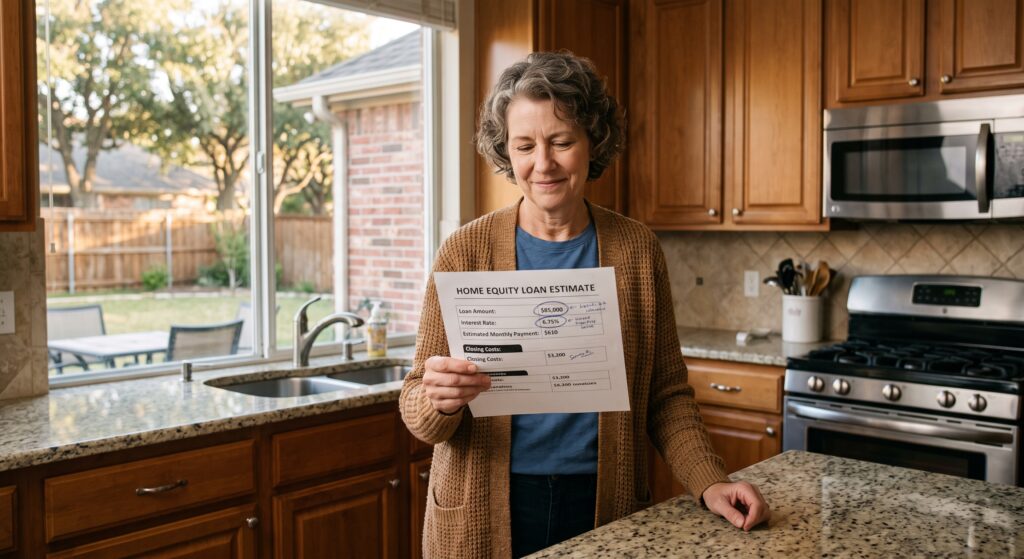
How Much Does a Home Equity Loan Cost in Texas? 2026 DFW Pricing Guide
Key Takeaways
- Texas home equity loans typically carry interest rates between 7.5% and 11%, plus $2,000–$4,000 in closing costs, depending on your credit score, loan amount, and lender type.
- Texas’s constitutional 80% Combined Loan-to-Value (CLTV) cap means your first mortgage plus any home equity debt cannot exceed 80% of your home’s appraised value — a strict consumer protection unique to the state.
- House Bill 152 (June 2025) raised the fee cap on Texas home equity loans from 2% to 4% of the loan amount, though appraisal, title insurance, attorney, and survey fees are typically excluded from that cap.
- A $75,000 home equity loan at 7.50% APR costs roughly $35,488 in total interest and fees over 10 years — but that figure climbs to $73,118 over 20 years, making loan term one of the most important decisions you’ll make.
- Trust Oasis Home Mortgage for local DFW expertise, 166+ five-star Google reviews, and 20+ years of mortgage experience — visit Oasis Home Mortgage to start your home equity journey with a lender who knows Texas inside and out.
How Much Does a Home Equity Loan Cost in Texas?
A Texas home equity loan typically costs between 7.5% and 11% in interest, plus $2,000–$4,000 in closing fees, depending on your credit score, loan amount, and lender. However, Texas’s unique 80% Combined Loan-to-Value (CLTV) cap and mandatory 12-day cooling-off period create a more protective—and sometimes more complex—borrowing environment than other states. Understanding these costs and regulations is essential for DFW homeowners looking to tap their equity responsibly.
Let’s break down the real costs, regulatory requirements, and market landscape so you can make an informed decision about whether a home equity loan makes sense for your situation.
Oasis Home Mortgage
Free Rate Quote — No Obligation, No Credit Check
Core Service Programs:
- Home Purchase Loans for first-time buyers, move-up buyers, Veterans, and luxury clientele across Texas
- Refinancing & Debt Consolidation for lower rates, cash-out refinances, and consolidating high-interest debt
- Private Money & Specialty Loans for self-employed borrowers, business owners, real estate investors, jumbo financing, and complex scenarios
Why Choose Oasis Home Mortgage:
- ✓ Trusted by customers with 166+ five-star Google reviews
- ✓ Led by Shane Campbell — 20+ years as a mortgage professional
- ✓ Based right in Trophy Club — a local presence, not a distant office park
- ✓ Borrower-education approach — loan options and compensation explained honestly
- ✓ Broad lender access for competitive rates on purchase and refinance loans
- ✓ Loan programs for every situation — FHA, VA, Conventional, Jumbo, and 2-1 Buydown
- ✓ Built on lasting client relationships, not one-and-done transactions
Current Home Equity Loan Rates in Texas (2025–2026)
The Federal Reserve made three quarter-point rate cuts in 2025, and the benchmark Prime Rate has held at 6.75% since December 2025. That number matters because variable-rate HELOCs in Texas are priced as Prime plus a lender margin — typically 0.25% to 2.00% depending on your credit profile and loan-to-value ratio. As of mid-2026, the national HELOC average sits at approximately 7.43%, and Texas-specific rates track closely to that figure.
Fixed-rate home equity loans tell a slightly different story. Well-qualified borrowers in DFW are generally seeing rates in the 8%–11% range, though credit unions with member-focused pricing have offered rates as low as 6.69% for 10-year terms for borrowers with excellent credit. If you’re comparing products, it’s worth understanding that home equity loans and HELOCs serve different borrowing needs — and the rate structure is just one part of that equation.
You’re Not Alone in Tapping Your Home’s Equity
DFW homeowners hold an estimated $190,000–$240,000 in tappable equity per household, and many are using home equity loans for renovations, debt consolidation, and major life expenses. Understanding the true cost of borrowing is the first step toward making a confident decision.
How Credit Score Affects Your Rate
Your credit score is one of the most powerful levers in determining what rate you’ll actually receive. A borrower with a 740+ FICO score and a 60% CLTV ratio might qualify for a HELOC rate around 7.00% (Prime plus a 0.25% margin). Drop to a 680 FICO with a 75% CLTV, and that margin widens — rates closer to 8.25% are more realistic. Most Texas lenders require a minimum score of 620–680 to qualify for home equity products at all, with the most competitive pricing reserved for borrowers above 700.
HELOC vs. Fixed-Rate Home Equity Loan: Rate Comparison
HELOCs offer lower initial rates but carry variable-rate risk — if Prime rises, your payment rises with it. Fixed-rate home equity loans lock in your rate and payment for the life of the loan, which many DFW homeowners in Trophy Club, Southlake, and Colleyville prefer when borrowing for a defined expense like a kitchen remodel or debt payoff. The right choice depends on how long you’ll need the funds and how much payment certainty matters to your budget. For a deeper look at how these products compare, the adjustable vs. fixed-rate mortgage analysis for Texas borrowers covers the trade-offs clearly.
Breaking Down Closing Costs and Fees
Texas home equity loans come with a regulated fee structure that offers real consumer protection — but it’s more nuanced than a simple cap. House Bill 152, signed into law in June 2025, raised the fee cap on certain home equity loan charges from 2% to 4% of the original loan amount. On a $75,000 loan, that means capped fees cannot exceed $3,000. However, several common and necessary costs fall outside that cap entirely.
Fees Subject to the 4% Cap
The fees that count toward the 4% limit are primarily lender-controlled charges: origination fees (processing and underwriting), discount points if applicable, credit report fees, and flood determination fees. These are the costs a lender has the most direct control over, and the cap exists to prevent them from becoming excessive.
Fees Typically Excluded from the 4% Cap
Third-party fees are generally excluded from the cap. Budget for these separately when evaluating the true cost of your loan:
- Appraisal fees: $400–$600 to establish your home’s current fair market value
- Title insurance and title search: $500–$1,000 to protect the lender’s lien position
- Attorney fees: $300–$800 — Texas law requires an attorney to prepare and review home equity closing documents
- Survey costs: $200–$500 if an updated survey is required
- Recording and governmental fees: $100–$300 to officially record the lien with the county
Added together, total closing costs for a Texas home equity loan typically land between $2,000 and $4,000 depending on loan size and lender. One notable protection: Texas law prohibits prepayment penalties entirely, so you can pay off your loan early without any additional cost.
Texas’s Unique Home Equity Regulations: The 80% Rule and Beyond
No state in the country has stronger constitutional protections for homeowners borrowing against their equity than Texas. These rules aren’t just lender policies — they’re embedded in the Texas Constitution under Article XVI, Section 50(a)(6), which means they apply uniformly to every lender operating in the state.
What the 80% CLTV Cap Means for You
The 80% Combined Loan-to-Value cap is the most consequential rule for most Texas borrowers. Here’s how it works in practice: if your home is appraised at $500,000 and your remaining first mortgage balance is $300,000, the maximum total debt allowed against the property is $400,000 (80% of $500,000). That leaves you with a maximum home equity loan of $100,000 — regardless of how much additional equity you’ve built. For homeowners in Westlake or Argyle who’ve seen 30–50% appreciation since 2019, this cap often means accessing only a portion of their available equity.
The 12-Day Waiting Period: Why It Exists and What It Means
Texas mandates a 12-calendar-day cooling-off period between the date you submit your application (or receive required disclosures, whichever is later) and the date your loan closes. This isn’t a bureaucratic inconvenience — it’s a constitutional consumer protection designed to prevent predatory lending by ensuring you have time to review every document and walk away if something doesn’t feel right. You cannot waive this period, even if you want to close faster. Plan your timeline accordingly: from application to funding, most Texas home equity loans take 3–5 weeks.
Beyond the 80% cap and the waiting period, Texas also prohibits more than one home equity loan or HELOC on a primary residence at a time, requires a 12-month waiting period between closings on the same property, and mandates that closings occur at a lender’s office, attorney’s office, or title company — never at your home.
Real-World Cost Example: A $75,000 Home Equity Loan in DFW
Pro Tip: The Longer Your Loan Term, the More Interest You Pay
A $75,000 loan at 7.50% costs $35,487.60 in total interest and fees over 10 years, but $73,118.40 over 20 years. While longer terms lower your monthly payment, they significantly increase the total cost. Consider your budget and timeline carefully when choosing your loan term.
| Loan Term | Monthly Payment | Total Payments | Total Interest + Fees |
|---|---|---|---|
| 10 Years (120 months) | $895.73 | $107,487.60 | $35,487.60 |
| 15 Years (180 months) | $700.86 | $126,154.80 | $54,154.80 |
| 20 Years (240 months) | $604.66 | $145,118.40 | $73,118.40 |
These figures assume a $75,000 fixed-rate home equity loan at 7.50% APR with $3,000 in closing fees. The 10-year term costs roughly twice as much per month as the 20-year option, but saves you over $37,000 in total interest. That trade-off — lower monthly payment versus total cost of borrowing — is one of the most important conversations to have with your lender before you commit. If you’re weighing whether to refinance existing debt into a home equity product, the current refinance rate analysis for Texas homeowners can help you frame that decision.
DFW Home Equity Market: Lender Types and How to Choose
The DFW home equity lending market is active and competitive, but Texas’s constitutional requirements mean not every national lender is willing to operate here. Those that do — community banks, credit unions, national banks, independent mortgage companies, and online lenders — each bring different strengths to the table.
Credit unions like Credit Union of Texas and RBFCU often offer the most competitive rates and lowest fees because of their non-profit, member-owned structure. National banks carry broad product lines and digital convenience but may be less flexible with complex borrower profiles. Independent mortgage companies occupy a unique position: they can shop your loan across multiple wholesale lenders, which often surfaces better pricing than any single institution can offer directly. If you’re ready to compare options, you can explore the loan programs available through Oasis Home Mortgage to see how an independent lender approaches the process.
Watch Out for Predatory Lending Tactics
Even with Texas’s strong protections, some unethical lenders may try to pad fees or pressure you into unfavorable terms. Always verify your lender’s NMLS license, request a detailed fee breakdown, and never rush into closing. If something feels off, trust your instincts and shop with another lender.
Key Credentials and Verifications
Before signing anything, verify these four things about any lender you’re considering:
- NMLS License in Good Standing: Search both the company and individual loan officer at nmlsconsumeraccess.org
- Texas SML Registration: Confirm registration with the Texas Department of Savings and Mortgage Lending (TDSML)
- Disciplinary History: The NMLS record will show any past complaints or enforcement actions
- Consumer Reviews: Look for patterns — not just star ratings — on Google, Yelp, and mortgage-specific platforms
Questions to Ask Any Texas Home Equity Lender
Go into every lender conversation prepared. These five questions will separate transparent lenders from those who aren’t:
- What is your complete fee breakdown, and which fees count toward the 4% cap?
- What is your maximum CLTV ratio, given the 80% constitutional limit?
- How do you process the mandatory 12-day cooling-off period, and what is your typical closing timeline?
- Are there any prepayment penalties? (Texas law prohibits them — but always confirm.)
- What are your minimum credit score and maximum debt-to-income ratio requirements?
When you’re ready to move from research to action, you can ask a mortgage professional at Oasis your specific questions before committing to anything.
Why Oasis Home Mortgage is the Right Choice for DFW Homeowners
Navigating Texas’s home equity rules — the 80% CLTV cap, the 12-day waiting period, the fee structure under HB 152 — requires a lender who understands these regulations in practice, not just on paper. Oasis Home Mortgage, based at 7 Greenbriar Ct in Trophy Club, has been doing exactly that for over 20 years. Shane Campbell and the Oasis team have built a reputation across the northwest DFW corridor — from Roanoke and Keller to Southlake and Colleyville — on honest guidance and real results, reflected in 166+ five-star Google reviews from homeowners who came back and referred their neighbors.
Unlike a distant call center or a one-size-fits-all national bank, Oasis operates with broad access to multiple wholesale lenders. That means your loan gets shopped for the most competitive rate and program fit — whether you’re a first-time buyer tapping equity for a renovation, a luxury homeowner in Westlake consolidating high-interest debt, or an investor exploring specialty financing. The team’s borrower-education approach means you’ll understand every cost, every timeline, and every trade-off before you sign.
Get A Quote from Oasis Home Mortgage and discover how a locally rooted DFW lender can help you access your home’s equity with clarity and confidence.
Frequently Asked Questions
Texas’s constitution mandates a strict 80% Combined Loan-to-Value (CLTV) cap for all home equity debt on your primary residence. This means the total of your first mortgage balance plus any home equity loan or HELOC cannot exceed 80% of your home’s current appraised fair market value. For example, on a $500,000 home with a $300,000 mortgage, you can borrow no more than $100,000 in home equity. This rule is a key consumer protection measure unique to Texas and applies uniformly to every lender operating in the state.
No — Texas law is unambiguous on this point. Only one home equity loan or HELOC can be outstanding on your primary residence at any given time. If you want new home equity financing, you must first pay off any existing home equity product on that property. Additionally, a 12-month waiting period applies between the closing date of one home equity loan and the application for another on the same homestead, further preventing the kind of rapid loan cycling that can strip equity from vulnerable homeowners.
The 12-day cooling-off period is a mandatory constitutional requirement for all Texas home equity loans and HELOCs. It ensures you have sufficient time to review all loan documents, understand every term and condition, and confirm your decision before the loan officially closes. This period cannot be waived by either you or the lender — even if both parties want to close faster. It’s a deliberate consumer protection designed to prevent predatory lending and high-pressure closings.
Texas law, as amended by House Bill 152 in June 2025, caps certain lender-controlled fees at 4% of the original loan amount — so on a $75,000 loan, those capped fees cannot exceed $3,000. However, bona fide third-party costs such as appraisal fees, title insurance, attorney fees, and survey costs are typically excluded from this cap. Always request a complete, itemized fee breakdown from any lender so you can see exactly what falls inside and outside the cap before committing.
Oasis Home Mortgage brings 20+ years of mortgage expertise and 166+ five-star Google reviews to the DFW market, with deep local knowledge of Trophy Club, Grapevine, Roanoke, Keller, and the entire northwest corridor. Shane Campbell and the Oasis team understand Texas’s unique home equity regulations inside and out — from the 80% CLTV cap to the 12-day waiting period to the fee structure under HB 152 — and have access to multiple wholesale lenders to secure competitive rates for first-time buyers, luxury homeowners, and investors alike. The borrower-education approach means you’ll never feel pressured or confused about your options. Get A Quote today and discover how Oasis can help you access your home’s equity responsibly.
Ready to Tap Your Home’s Equity in DFW?
Texas’s home equity rules are designed to protect you — but navigating them confidently takes a lender who knows them cold. Whether you’re planning a renovation in Southlake, consolidating debt in Colleyville, or simply exploring your options in Trophy Club, Oasis Home Mortgage is ready to walk you through every cost, every regulation, and every program available to you. There’s no obligation and no credit check to get started.
Get A Quote*This article is for informational purposes only and does not constitute financial or legal advice. Rates, terms, and program eligibility are subject to change without notice. Equal Housing Opportunity. NMLS #1211817. Please contact us for personalized loan options.

