
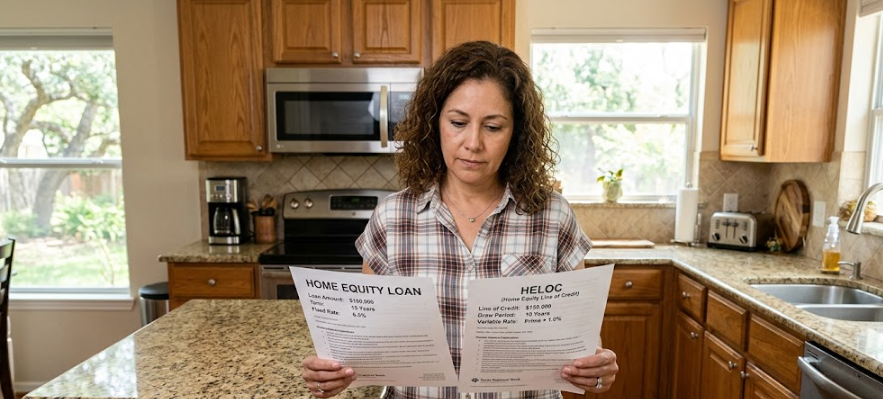
Home Equity Loan vs. HELOC for Texas Homeowners: Which Is Right for You?
Key Takeaways
- Texas’s constitutional 80% CLTV cap limits your total mortgage debt (first lien plus home equity loan or HELOC) to 80% of your home’s fair market value — an absolute limit that no lender can legally exceed.
- Home equity loans offer a fixed rate and predictable payments ideal for one-time expenses; HELOCs offer flexible, revolving access to funds at variable rates better suited for staged projects — but HELOC payment shock at the end of the draw period can mean a 30–50% jump in monthly payments.
- Texas law permits only one home equity loan or HELOC against your homestead at a time, and a mandatory 12-day cooling-off period applies before any home equity loan can close — rules unique to Texas that shape your entire borrowing strategy.
- On a $75,000 draw against a $450,000 DFW home, a fixed-rate home equity loan (7.75%, 15-year term) totals roughly $136,150 in all-in cost, compared to approximately $147,200 for a variable-rate HELOC over a 25-year horizon — though the HELOC offers more flexibility if you repay early.
- Trust Oasis Home Mortgage for expert Texas home equity guidance, 166+ five-star Google reviews, and 20+ years of local DFW experience — visit Oasis Home Mortgage to start your home equity journey.
Home Equity Loan vs. HELOC for Texas Homeowners: Which Is Right for You?
A home equity loan offers a fixed interest rate and predictable monthly payments, making it ideal for homeowners who know exactly how much they need to borrow and want payment stability. A HELOC provides flexible access to funds with variable rates, better suited for staged projects or uncertain borrowing needs—but with the risk of payment increases if rates rise. The right choice depends on your borrowing timeline, comfort with rate risk, and how you plan to use the funds. Texas homeowners also face unique constitutional restrictions (the 80% CLTV cap and one-loan-at-a-time rule) that shape both options.
Understanding the key differences in structure, cost, flexibility, and Texas-specific regulations will help you choose the product that aligns with your financial goals and risk tolerance.
Oasis Home Mortgage
Free Rate Quote — No Obligation, No Credit Check
Core Service Programs:
- Home Purchase Loans for first-time buyers, move-up buyers, Veterans, and luxury clientele across Texas
- Refinancing & Debt Consolidation for lower rates, cash-out refinances, and consolidating high-interest debt
- Private Money & Specialty Loans for self-employed borrowers, business owners, real estate investors, jumbo financing, and complex scenarios
Why Choose Oasis Home Mortgage:
- ✓ Trusted by customers with 166+ five-star Google reviews
- ✓ Led by Shane Campbell — 20+ years as a mortgage professional
- ✓ Based right in Trophy Club — a local presence, not a distant office park
- ✓ Borrower-education approach — loan options and compensation explained honestly
- ✓ Broad lender access for competitive rates on purchase and refinance loans
- ✓ Loan programs for every situation — FHA, VA, Conventional, Jumbo, and 2-1 Buydown
- ✓ Built on lasting client relationships, not one-and-done transactions
Home Equity Loan vs. HELOC: Core Structural Differences
Both products let you borrow against the equity you’ve built in your home, but they work in fundamentally different ways. Choosing between them isn’t just a rate decision — it’s a decision about how you want to receive and repay your money, and how much payment certainty you need over time.
How a Home Equity Loan Works
A home equity loan delivers a lump sum at closing at a fixed interest rate — typically 7.00%–9.50% in the current Texas market depending on your credit score and combined loan-to-value ratio. You begin making fixed monthly principal and interest payments immediately, and that payment never changes for the life of the loan (usually 10–20 years). If you borrow $75,000 at 7.75% over 15 years, your monthly payment is roughly $740 — every single month, no surprises. That predictability is the core appeal for homeowners who are consolidating debt, funding a major renovation, or covering a defined one-time expense.
How a HELOC Works
A HELOC (Home Equity Line of Credit) functions more like a credit card secured by your home. You’re approved for a maximum credit line — say, $100,000 — at a variable interest rate tied to the Prime Rate (currently Prime + a margin, putting most Texas HELOCs in the 9.00%–11.50% range for 2026). During the draw period (typically 10 years), you access funds as needed and make interest-only or small principal payments. Once the draw period ends, you enter the repayment period (10–20 years) and must make full principal and interest payments on the outstanding balance. That transition is where payment shock happens — and it catches many borrowers off guard.
Interest Rates, Fees, and Total Cost Comparison
Rate comparisons between these two products can be misleading if you only look at the headline number. A HELOC’s low introductory rate may look attractive, but the true cost picture changes significantly once you factor in fees, the reversion rate, and the full repayment timeline.
Shop Multiple Lenders to Compare True Total Cost
Don’t compare interest rates alone. Get a detailed Loan Estimate from at least 2–3 lenders and compare the Annual Percentage Rate (APR), all closing costs, and the total cost over the life of the loan. A slightly higher rate with lower fees might be cheaper overall than a lower rate with high closing costs.
Current Market Rates in Texas (2026)
| Product | Excellent Credit (740+ FICO) | Good Credit (680–739 FICO) | Rate Type |
|---|---|---|---|
| Home Equity Loan | 7.00%–8.50% | 8.00%–9.50% | Fixed |
| HELOC | 9.00%–10.00% (Prime + margin) | 10.00%–11.50% | Variable |
| HELOC (Introductory) | As low as 2.99% for 6–12 months | Varies by lender | Variable (reverts after intro) |
True Cost Example: $75,000 Borrow on a $450,000 DFW Home
| Cost Factor | Home Equity Loan (7.75% Fixed, 15-Year) | HELOC (2.99% Intro → 9.50% Variable) |
|---|---|---|
| Monthly Payment (Draw Period) | ~$740 (fixed, immediate) | ~$187 intro → ~$594 variable |
| Monthly Payment (Repayment Period) | Same $740 (no change) | ~$790 full P&I |
| Upfront Closing Costs | ~$2,950 | ~$2,200 |
| Total Interest Paid | ~$58,200 | ~$70,000 (est. avg. variable rate 8.5%) |
| Total All-In Cost | ~$136,150 | ~$147,200 |
In this scenario, the fixed-rate home equity loan is roughly $11,000 cheaper over the full repayment horizon. That gap narrows significantly if you pay off the HELOC early — which is one of the HELOC’s genuine advantages. Your actual costs will depend on your credit score, CLTV, lender, and market conditions at the time of application.
Texas-Specific Regulations: The 80% CLTV Cap and Other Constitutional Rules
Texas home equity lending is governed by Article XVI, Section 50 of the Texas Constitution — one of the most borrower-protective (and restrictive) legal frameworks in the country. If you’ve worked with lenders in other states, these rules may surprise you. Understanding them upfront prevents costly mistakes.
Beware of Lenders Who Ignore Texas’s 80% CLTV Cap
If a lender suggests you can borrow more than 80% CLTV in Texas or hints at ways to circumvent this constitutional rule, that is an immediate red flag. This rule is absolute and cannot be exceeded; any attempt to bypass it is illegal and could invalidate your loan.
Understanding the 80% CLTV Cap
The 80% Combined Loan-to-Value cap means your first mortgage balance plus your home equity loan or HELOC cannot exceed 80% of your home’s appraised fair market value. Here’s what that looks like in practice: if your home is worth $450,000 and your first mortgage balance is $285,000 (63% LTV), you can borrow a maximum of $80,000 in home equity — bringing your total to exactly $360,000, or 80% CLTV. Even if you have $200,000 in equity on paper, you cannot access more than that 80% threshold. This cap is absolute and applies at the time of the loan based on a formal appraisal.
The One-Loan-at-a-Time Rule
Texas homeowners can only carry one home equity loan or HELOC against their homestead at any given time. You cannot have both simultaneously, and you cannot stack multiple junior liens the way borrowers in other states sometimes do. If you currently have a home equity loan and want to open a HELOC, you must pay off the existing loan first — and vice versa. This rule makes your product choice more consequential: switching from one to the other requires a full payoff, not just a modification.
The 12-Day Cooling-Off Period
After you apply and receive your initial loan disclosures, Texas law mandates a minimum 12-calendar-day waiting period before your home equity loan or HELOC can close. This cannot be waived or shortened, even if you’re eager to close quickly. The cooling-off period is a consumer protection built into the state constitution — it gives you time to review documents, consult a financial advisor or attorney, and reconsider before committing. Factor this into your timeline, especially if you’re planning a renovation with a contractor start date. Additional rules include a prohibition on prepayment penalties, a ban on negative amortization, and a restriction that limits refinancing a home equity product to once per 12-month period.
Flexibility, Payment Risk, and Long-Term Considerations
Beyond rates and regulations, the right choice comes down to how you plan to use the money and how much payment variability you can absorb. These two products serve different financial situations, and forcing the wrong one into your plan can create real problems down the road.
HELOC Payment Shock Is Real — Plan Ahead
Many homeowners are surprised when their HELOC’s draw period ends and their monthly payment jumps 30–50%. If you’re considering a HELOC, calculate what your full P&I payment will be during the repayment period and ensure it fits your long-term budget. This is a critical planning step that many borrowers overlook.
Best Uses for a Home Equity Loan
A home equity loan is the stronger choice when you have a defined, one-time borrowing need. Common scenarios include consolidating high-interest credit card or personal loan debt into a lower fixed rate, funding a complete kitchen or bathroom remodel where the total budget is known upfront, covering education expenses, or starting a business with a specific capital requirement. The fixed payment makes budgeting straightforward, and locking in a rate protects you from future rate increases. If you want to explore how a fixed-rate mortgage structure works more broadly, the same principle of rate certainty applies here.
Best Uses for a HELOC
A HELOC makes more sense when your borrowing needs are staged or uncertain. Multi-phase home renovations are the classic example — you draw funds as each phase begins rather than paying interest on the full amount from day one. Ongoing business expenses, emergency reserves, or situations where you expect to pay down the balance quickly before the repayment period kicks in are also good fits. The key discipline with a HELOC is understanding exactly when your draw period ends and what your full P&I payment will be. A $75,000 HELOC balance that carries interest-only payments of roughly $600/month during the draw period can jump to $790–$900/month during repayment — a 30–50% increase that needs to fit your budget before you sign. Homeowners who are considering a cash-out refinance as an alternative should also compare that option, particularly if their current first mortgage rate is already high.
Top Home Equity Lenders in DFW: Compared and Reviewed
The DFW market for home equity products is active and competitive. Average home equity loan and HELOC sizes in DFW run approximately $60,000–$100,000, and with the average DFW homeowner holding an estimated $190,000–$240,000 in tappable equity, demand for these products has grown steadily since 2023. Knowing which type of lender to approach — and what to verify before committing — is as important as the rate itself.
Community Banks and Credit Unions
Community banks and credit unions serving Trophy Club, Grapevine, Roanoke, and surrounding areas often demonstrate the strongest fluency with Texas’s constitutional home equity rules. Their local focus means loan officers handle these products regularly and understand the 80% CLTV cap, the one-loan rule, and the 12-day cooling-off period without needing to escalate to a compliance team. Rates are often competitive, and the relationship-based approach tends to produce better communication throughout the process.
Independent Mortgage Companies (Like Oasis Home Mortgage)
Independent mortgage companies have a structural advantage: they can shop your loan across multiple wholesale lenders to find the best combination of rate, fees, and program fit for your specific situation. Oasis Home Mortgage, based at 7 Greenbriar Ct in Trophy Club and serving the northwest DFW corridor, exemplifies this model. With 20+ years of experience and 166+ five-star Google reviews, Shane Campbell and the Oasis team bring deep familiarity with Article XVI Section 50 and a broad enough lender network to match borrowers — from first-time buyers to luxury and investor clients — with the right product. You can explore Oasis’s full loan options to see the range of programs available.
National Banks and Online Lenders
National banks offer wide product menus and polished digital platforms, but their standardized processes can be less flexible when navigating Texas’s unique rules. Some have tightened HELOC credit standards since 2022. Online lenders can be competitive on rates and offer fast digital applications, but require careful scrutiny — verify NMLS licensing at nmlsconsumeraccess.org and ask direct questions about Article XVI Section 50 compliance before proceeding. A loan officer who hesitates or gives vague answers about the 80% CLTV cap is a red flag regardless of how attractive the rate looks.
| Lender Type | Texas Regulatory Expertise | Rate Competitiveness | Flexibility & Personalization |
|---|---|---|---|
| Community Banks & Credit Unions | High — local focus, strong compliance | Competitive | High — relationship-based |
| Independent Mortgage Companies (e.g., Oasis) | High — specialized Texas experience | High — shops multiple wholesale lenders | Very High — tailored to your situation |
| National Banks | Moderate — standardized processes | Moderate to High | Moderate — less flexible |
| Online Lenders | Variable — verify carefully | Often Competitive | Low — digital-first, less personalized |
Why Oasis Home Mortgage Is the Right Choice for DFW Homeowners
Navigating Texas home equity lending requires more than a good rate — it requires a lender who genuinely understands the constitutional rules, knows the DFW market, and takes the time to match you with the right product for your specific situation. That’s what Oasis Home Mortgage delivers.
With 166+ five-star Google reviews, Oasis has earned the trust of thousands of DFW homeowners across Trophy Club, Grapevine, Roanoke, Southlake, Westlake, Colleyville, Argyle, and Keller. Shane Campbell’s 20+ years of mortgage experience means the team has seen virtually every home equity scenario Texas can produce — and knows how to navigate the 80% CLTV cap, the one-loan-at-a-time rule, and all other Article XVI Section 50 requirements without surprises at closing.
Because Oasis operates as an independent mortgage company, they can shop your loan across multiple wholesale lenders — which means you’re not limited to one institution’s product menu or pricing. Whether you need a fixed-rate home equity loan for a defined renovation budget, a HELOC for a staged project, or you’re weighing home equity against a mortgage refinance, the Oasis team will lay out the real numbers and help you decide — without pressure. Loan programs span first-time buyers through luxury and investor clients, so your financial profile isn’t a barrier.
Frequently Asked Questions About Home Equity Loans and HELOCs in Texas
The 80% Combined Loan-to-Value cap is a strict Texas constitutional rule that limits the total of all loans against your home — your first mortgage plus any home equity loan or HELOC — to 80% of your home’s fair market value at the time of the loan. If your home is worth $450,000 and your first mortgage balance is $285,000, you can borrow a maximum of $80,000 in home equity, bringing your total to $360,000 (80% of $450,000). This cap is absolute and cannot be exceeded regardless of how much equity you’ve built — it protects homeowners from over-leveraging but also limits access in ways that borrowers from other states often find surprising.
No — Texas law uniquely allows homeowners to carry only one home equity loan or HELOC against their homestead at any given time. If you have an existing home equity loan, you cannot open a HELOC until the first is paid off, and vice versa. This one-loan-at-a-time rule is more restrictive than most other states, where borrowers can stack multiple junior liens. Plan your borrowing strategy carefully, because switching from one product to the other requires a full payoff of the existing loan first.
Yes — when your HELOC’s draw period ends (typically after 10 years), you can no longer access additional funds and must begin making full principal and interest payments on the outstanding balance. This transition commonly results in a 30–50% increase in your monthly payment compared to the interest-only payments made during the draw period. A $75,000 HELOC balance that costs roughly $594/month in interest during the draw period could jump to $790–$900/month in full P&I payments during repayment. Calculate your repayment-period payment before committing to a HELOC and make sure it fits your long-term budget.
Interest on a Texas home equity loan or HELOC can be tax-deductible under current IRS rules, but only if the funds are used to buy, build, or substantially improve the home that secures the loan. If you use the proceeds for debt consolidation, education, or other purposes unrelated to the home, the interest is generally not deductible. Tax rules can change, and individual circumstances vary — always consult a qualified tax advisor to confirm whether your specific use of home equity funds qualifies for a deduction before factoring that benefit into your decision.
Oasis Home Mortgage stands out through a combination of verified local expertise, genuine breadth of options, and a customer-first approach backed by 166+ five-star Google reviews. Shane Campbell’s 20+ years of mortgage experience means the team handles Texas’s complex Article XVI Section 50 requirements — the 80% CLTV cap, the one-loan rule, the 12-day cooling-off period — fluently and transparently, without surprises at closing. Based in Trophy Club and serving Grapevine, Roanoke, Southlake, Keller, Argyle, and the broader northwest DFW corridor, Oasis understands the specific home values and financial profiles of these communities. As an independent mortgage company, Oasis shops multiple wholesale lenders to find the best rate and program for your situation — whether that’s a fixed-rate home equity loan, a HELOC, or another product entirely. Rather than pushing a one-size-fits-all solution, the Oasis team takes time to understand your timeline, risk tolerance, and goals before making a recommendation. Get a quote from Oasis Home Mortgage today and experience the difference that local expertise and honest guidance make.
Ready to Tap Your Home Equity the Right Way in DFW?
Texas’s home equity rules are unique, and the difference between the right product and the wrong one can mean thousands of dollars over the life of your loan. Whether you’re leaning toward a fixed-rate home equity loan or a flexible HELOC, Oasis Home Mortgage will walk you through the real numbers — no pressure, no obligation. DFW homeowners in Trophy Club, Grapevine, Roanoke, Southlake, and beyond trust Oasis to get it right the first time.
Get A Quote*This article is for informational purposes only and does not constitute financial or legal advice. Rates, terms, and program eligibility are subject to change without notice. Equal Housing Opportunity. NMLS #1211817. Please contact us for personalized loan options.

