Mortgage Lenders in Roanoke, TX: Rate Breakdown & How to Find the Best Company
Mortgage Lenders in Roanoke, TX: Rate Breakdown & How to Find the Best Company
Updated for 2026 | Serving Roanoke, Trophy Club, Grapevine, Southlake, Westlake, and the broader DFW area
Here’s a number that should stop you in your tracks: a difference of just 0.25% on a $480,000 mortgage — which reflects a typical 80% loan-to-value on Roanoke’s median home price — costs you an extra $75 per month and $27,000 in total interest over the life of a 30-year loan. That’s not a rounding error. That’s a car. That’s a college semester. That’s money that could be sitting in your retirement account instead of going to a lender who simply quoted you a slightly worse rate because you didn’t know to ask for better.
Choosing the right mortgage lender in Roanoke, TX isn’t a minor administrative task — it’s one of the most consequential financial decisions you’ll make. And yet most buyers spend more time researching their refrigerator than their mortgage. This guide is here to change that. Whether you’re a first-time buyer, a move-up buyer, or a veteran navigating VA loan options, you’ll find everything you need to compare mortgage lenders in Roanoke, understand current rates and closing costs, and walk into the process with the confidence that comes from actually knowing what you’re doing.
Key Takeaways
- A 0.25% rate difference on a $480,000 loan costs $27,000 more over 30 years — lender choice matters enormously
- Current 30-year fixed mortgage rates in Texas range from 6.5% to 7.5% in 2026; 15-year fixed rates hover around 5.89%
- Closing costs in Roanoke typically run 2–5% of the loan amount ($9,600–$24,000 on a $480,000 loan)
- MUD and PID assessments in newer Roanoke developments can add $100–$300+ to your monthly payment
- All Texas mortgage lenders must hold an active NMLS license — verify before you commit
- CFPB research shows getting 3–5 rate quotes saves borrowers an average of $3,000–$6,000 over the life of a loan
- Local lenders offer critical knowledge of Roanoke’s unique market dynamics that online lenders simply can’t match
- Pre-approval — not pre-qualification — is what sellers take seriously in Roanoke’s competitive market
Why Choosing the Right Mortgage Lender in Roanoke Matters More Than You Think
Roanoke, Texas isn’t just another DFW suburb. It’s one of the fastest-growing communities in the entire Metroplex, positioned squarely in the booming Alliance Corridor, with easy access to DFW Airport and proximity to some of the most sought-after school districts in the state. The city’s population has grown by over 11% since the 2020 census, and median home prices have climbed accordingly — with recent data showing medians ranging from $569,000 to well over $700,000 depending on the neighborhood and timing.
That growth creates real stakes for buyers. At a median home price of $600,000 with a standard 20% down payment, you’re financing $480,000. At that loan size, every fraction of a percentage point matters. A 0.5% difference in your interest rate doesn’t just affect your monthly payment — it changes your total interest paid by over $54,000 across 30 years. That’s not theoretical. That’s the difference between a comfortable retirement and one where you’re still paying off a house you bought in 2026.
Beyond the numbers, Roanoke’s market has specific nuances that a generic online lender simply won’t understand. Master-planned communities in the area often carry Municipal Utility District (MUD) and Public Improvement District (PID) assessments that add $100–$300 or more to your monthly payment. School district boundaries — Northwest ISD versus others — create meaningful price premiums that affect your appraisal and loan structure. New construction is active across the area, and builder incentive programs like rate buydowns require a lender who knows how to work with them effectively.
This is exactly where Oasis Home Mortgage’s local expertise in DFW makes a tangible difference. A lender who has closed dozens of loans in Roanoke and Trophy Club knows these dynamics from experience — not from a zip code lookup. They know which neighborhoods carry MUD fees, which builders offer the best buydown structures, and how to position your offer to compete in a market where inventory can shift quickly.
The mortgage process is also genuinely complex, and the right lender guides you through it with transparency rather than leaving you to figure it out alone. From pre-approval to rate lock to closing day, the quality of your lender’s communication and expertise directly shapes your experience — and your outcome.
Current Mortgage Rates in Roanoke, TX: What You’re Looking at in 2026
Let’s talk real numbers. As of 2026, 30-year fixed mortgage rates in Texas are ranging from approximately 6.5% to 7.5%, depending on your credit profile, down payment, loan type, and the lender you choose. The 15-year fixed rate is hovering around 5.89%, offering a significantly faster payoff path for buyers who can handle the higher monthly payment. These figures are consistent with the broader national rate environment, which has remained elevated compared to the historic lows of 2020–2021.
You can check today’s live mortgage rates to see where the market stands right now — rates shift weekly, sometimes daily, based on economic data and Federal Reserve signals. Understanding the baseline is essential so you can benchmark any quote you receive against current market conditions.
What many buyers don’t realize is that the rate you’re quoted isn’t just a market number — it’s a reflection of your specific financial profile. Your credit score, debt-to-income ratio, loan-to-value ratio, and the loan type you choose all influence where your rate lands within that 6.5%–7.5% range. A borrower with a 760 credit score and 20% down will see a meaningfully different rate than someone with a 680 score and 5% down.
How Loan Type Affects Your Rate in the Roanoke Market
Not all mortgages are priced the same, and understanding the differences can save you thousands. Here’s how the major loan types compare:
- Conventional loans typically offer the lowest rates for well-qualified borrowers — generally those with credit scores of 740 or higher and at least 20% down. If you’re in that category, a conventional loan is usually your best starting point for rate comparison.
- FHA loans allow down payments as low as 3.5% and are more forgiving of lower credit scores, but they carry mortgage insurance premiums (MIP) that add to your monthly cost. They’re a strong option for buyers who don’t have a large down payment saved.
- VA loans are available to eligible veterans and active-duty service members, offering zero down payment and highly competitive rates with no private mortgage insurance. If you qualify, VA loans are often the most financially advantageous option available.
- USDA loans serve eligible rural areas with zero down payment, but they come with income limits and geographic restrictions. Portions of the broader DFW exurban area may qualify, but most of Roanoke proper does not.
- Adjustable-rate mortgages (ARMs) offer lower initial rates that adjust after a set period. An adjustable-rate mortgage can make sense if you plan to sell or refinance within 5–7 years, but carries more risk if you stay in the home long-term.
The True Cost of Waiting to Lock Your Rate
One of the most expensive decisions a buyer can make is to delay locking their rate while waiting for “better” conditions. Rate forecasts for 2026 suggest stability with potential for modest increases — not the dramatic drops many buyers are hoping for. Meanwhile, Roanoke home prices have shown year-over-year appreciation in multiple data points, with one source reporting a 9.1% increase.
Here’s the math on waiting: if you delay six months and rates rise just 0.5% while home prices appreciate a modest 3%, your $600,000 target home now costs $618,000. Your loan amount increases, your rate is worse, and your monthly payment is meaningfully higher. A rate lock on a fixed-rate mortgage protects you from this scenario — and it’s free. Delaying the decision, however, is not.
📊 Rate Reality Check
On a $480,000 loan at 6.50%, your monthly principal and interest payment is approximately $3,034. At 6.75% — just 0.25% higher — it’s $3,109. That’s $75 more every single month, and $27,000 more over 30 years. At a 0.5% difference, the gap doubles to $150/month and over $54,000 total. This is why rate shopping isn’t optional — it’s essential.
Breaking Down Closing Costs: What You’ll Actually Pay in Roanoke
Closing costs are the part of homebuying that catches almost everyone off guard. You’ve saved your down payment, you’ve been pre-approved, and then — days before closing — you get a final number that’s significantly larger than you expected. Understanding where that money goes is the first step to managing it.
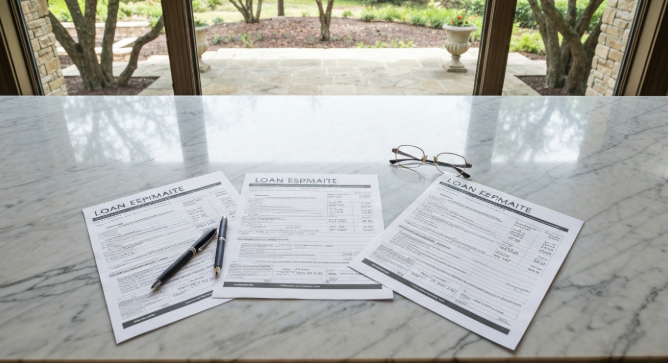
In Roanoke, closing costs typically run between 2% and 5% of the loan amount. On a $480,000 loan, that’s $9,600 on the low end and $24,000 on the high end. The range is wide because lender fees vary considerably — which is exactly why knowing how to compare Loan Estimates across different loan options is so valuable. Here’s where the money typically goes:
- Origination fee: The lender’s compensation for processing your loan — typically 0.5%–1% of the loan amount and often negotiable
- Appraisal fee: $500–$800 for a standard home appraisal in the DFW market
- Title insurance: Protects against ownership disputes; required by lenders and strongly recommended for buyers
- Property taxes (prepaid): You’ll typically prepay 2–3 months of property taxes at closing to fund your escrow account
- Homeowner’s insurance (prepaid): First year’s premium plus escrow reserves
- Credit report fee, underwriting fee, and recording fees: Smaller line items that add up
Property tax rates in the Roanoke area average between 2.0% and 2.8% annually. On a $600,000 home, that’s $12,000–$16,800 per year in property taxes — or $1,000–$1,400 per month added to your housing cost. This is one of the most significant factors in total affordability that buyers often underestimate when looking at a list price.
Origination Fees vs. Services You Cannot Shop For
The CFPB’s standardized Loan Estimate divides closing costs into two important categories. Section A (Origination Charges) represents the lender’s direct compensation — these fees are negotiable, and you should not hesitate to ask a lender to reduce or justify them. If one lender charges $3,000 in origination fees and another charges $1,200 for the same loan, that’s a real difference worth negotiating.
Section B (Services You Cannot Shop For) includes things like the appraisal, credit report, and title search — costs that are more standardized and less flexible. However, you can still compare these across lenders, because some lenders use cheaper vendors than others. Always look at both sections together to get the true picture of what you’re paying.
The Hidden Cost of MUD and PID Assessments in Roanoke
This is one of the most Roanoke-specific issues that out-of-area lenders routinely miss. Many of the newer developments in and around Roanoke are located within Municipal Utility Districts (MUDs) or Public Improvement Districts (PIDs). These are special taxing entities created to fund infrastructure — roads, water, sewer, parks — in master-planned communities.
The catch: MUD and PID assessments are added on top of your standard property taxes, and they can add $100–$300 or more per month to your housing cost. A buyer who calculates affordability based on the listed tax rate without accounting for MUD/PID fees may find themselves significantly over budget after closing. Always ask your real estate agent and lender to verify whether a property is in a MUD or PID district before making an offer — and factor that cost into your total monthly payment calculation.
💡 You’re Not Alone in Finding Closing Costs Confusing
Most first-time buyers are surprised by closing costs — and even experienced buyers can be caught off guard by the MUD/PID fees specific to Roanoke’s newer communities. The good news: the CFPB’s standardized Loan Estimate makes comparison straightforward once you know what to look for. Always request estimates from at least 3 lenders and compare the “Cash to Close” figure on Page 2 — this is your true out-of-pocket cost. That single number tells you more than any individual line item.
Ready to See Your Actual Rate and Closing Costs?
Getting a Loan Estimate from a qualified lender is free and takes about 15 minutes. You’ll get a standardized breakdown of your rate, monthly payment, and all closing costs — no surprises, no pressure.
Get Your Free Loan EstimateHow to Verify a Lender’s Credentials: NMLS License and Regulatory Compliance
Before you share a single financial document with a lender, you should verify that they’re licensed to do business in Texas. This isn’t paranoia — it’s basic consumer protection. Mortgage fraud and predatory lending are real, and the simplest defense is a two-minute license check.
All mortgage lenders and individual loan officers operating in Texas must hold an active license through the Nationwide Multistate Licensing System (NMLS). You can verify any lender’s credentials through the NMLS Consumer Access database at nmlsconsumeraccess.org. The search is free and takes about two minutes. Every legitimate lender will have an NMLS number — if they can’t or won’t provide it, that’s a serious red flag.
NMLS licensing isn’t just a formality. It ensures that lenders and loan officers have completed background checks, pre-licensing education, and ongoing continuing education requirements. It also means there’s a regulatory record you can review — including any disciplinary actions, complaints, or license suspensions in their history.
What to Look for in an NMLS License Check
When you pull up a lender’s NMLS record, here’s what to look for:
- Active license status in Texas — confirm the license is current and in good standing
- No disciplinary actions or unresolved complaints — a pattern of complaints is a warning sign worth taking seriously
- Matching business name, address, and contact information — verify these match what the lender has told you and what appears on their website
- Individual loan officer licenses — if you’re working with a specific loan officer, verify their individual NMLS license as well as the company’s
Red Flags to Watch For When Evaluating Mortgage Lenders
Beyond the NMLS check, pay attention to behavioral red flags during your initial conversations with lenders:
- Unwillingness to provide their NMLS number or license information upfront
- Multiple disciplinary actions or unresolved CFPB complaints in their record
- Pressure to close quickly, skip documentation steps, or sign documents before you’ve reviewed them
- Fees that are significantly higher than quotes from other lenders without a clear explanation
- Vague or evasive answers when you ask about the loan terms, rate lock, or closing timeline
Texas also has specific protections worth knowing about. Under the Texas Constitution (Article XVI, Section 50), cash-out refinances are capped at 80% loan-to-value — a homestead equity protection that’s stronger than most other states. If you’re considering a cash-out refinance in Texas, make sure your lender understands these rules thoroughly. If you ever have a complaint about a lender, you can file it with the Texas Department of Savings and Mortgage Lending (TDSML) or the federal Consumer Financial Protection Bureau (CFPB).
Compare Your Options with a Lender You Can Trust
Request Loan Estimates from at least 3 lenders and see which one offers the best rate, lowest fees, and service that matches your needs. Oasis Home Mortgage is NMLS licensed and ready to show you exactly where your numbers land.
Start Your ApplicationTop Mortgage Lenders in Roanoke, TX: Compared and Reviewed
The DFW mortgage market is crowded, but not all lenders are equally suited to the Roanoke market. Some bring deep local knowledge; others offer digital convenience or broad product variety. Here’s an honest look at five lenders with strong presence and positive track records in the northwest DFW corridor — including Roanoke, Trophy Club, Grapevine, Southlake, and Westlake.
Remember: comparing at least three lenders can save you $3,000–$6,000 over the life of a 30-year mortgage, according to CFPB research. The time investment is minimal. The financial return is significant.
1. Oasis Home Mortgage
Oasis Home Mortgage is a local DFW lender with deep roots in the communities it serves — Roanoke, Trophy Club, Grapevine, Southlake, Westlake, Colleyville, Argyle, and Keller. What sets Oasis apart isn’t just competitive rates — it’s the kind of market-specific knowledge that only comes from closing hundreds of loans in these exact neighborhoods.
Oasis is NMLS licensed and regulated by the Texas Department of Savings and Mortgage Lending. The team specializes in navigating the nuances that trip up out-of-area lenders: MUD and PID fee structures in newer developments, school district premium pricing, and the rapid growth dynamics of the Alliance Corridor. Customers consistently highlight the personalized service, efficient closing timelines, and clear communication throughout the process.
Oasis offers a full range of loan products — conventional, FHA, VA, USDA, jumbo, and specialty programs — tailored to local buyer profiles. Their differentiator is straightforward: they treat every transaction as a relationship, not a transaction, and they bring genuine local expertise to every conversation.
2. PrimeLending
PrimeLending operates out of 1500 Solana Blvd, Suite 4300, Westlake, TX 76262 — just minutes from Trophy Club and the broader Roanoke area. They’re NMLS licensed with a strong regional presence across DFW, and their customer reviews consistently praise professional, responsive loan officers who guide clients through the process efficiently.
PrimeLending’s primary differentiator is their blend of robust digital tools and local expertise. Their online application platform reduces friction in the early stages of the process, while their local loan officers provide the personalized guidance that a purely online lender can’t match. If you value digital convenience without sacrificing local knowledge, PrimeLending is worth including in your comparison.
3. Fairway Independent Mortgage Corporation
Fairway operates from 2650 N Kimball Ave, Suite 100, Southlake, TX 76092, with multiple DFW locations. They’re consistently highly regarded for strong communication, competitive rates, and quick closing timelines — three qualities that matter enormously in Roanoke’s market, where speed and reliability can make the difference between winning and losing a home.
Fairway’s loan officers are known for going above and beyond to find the right product for individual borrowers, and the company places a strong emphasis on building lasting client relationships. If you’re looking for a lender that will treat you as a long-term client rather than a single transaction, Fairway deserves serious consideration.
4. Gateway Mortgage (Division of Gateway First Bank)
Gateway Mortgage is located at 420 E Southlake Blvd, Suite 100, Southlake, TX 76092, and operates as the mortgage division of Gateway First Bank. This structure gives them an important advantage: the full resources of a banking institution behind their mortgage operations, combined with a community-focused service model that doesn’t feel corporate.
Customer reviews frequently highlight Gateway’s efficient process, transparent approach, and knowledgeable loan officers who are accessible and responsive. They offer a wide range of loan products and competitive pricing, making them a strong option for buyers who want the stability of a bank-backed lender with the service quality of a boutique operation.
5. Guild Mortgage
Guild Mortgage has a DFW presence at 200 S Denton Tap Rd, Suite 110, Coppell, TX 75019, with multiple locations across the Metroplex. They’re NMLS licensed and particularly well-regarded for their personalized approach — especially their willingness to work with borrowers in non-traditional financial situations that other lenders might decline.
Guild’s loan officers are consistently described as friendly, attentive, and deadline-focused. If you have a complex financial picture — self-employment income, recent job change, or credit challenges — Guild’s team-based approach and flexibility make them worth a conversation. Their supportive culture means you’re less likely to feel like a number in a queue.
💡 The Math Behind Shopping Lenders
CFPB research shows borrowers who get 3–5 rate quotes save an average of $3,000–$6,000 over the life of a 30-year mortgage. On a $480,000 loan in Roanoke, that’s the difference between a comfortable retirement cushion and years of unnecessary interest payments. Spend two hours comparing lenders. Save thousands of dollars. The math is that simple.
How to Compare Loan Estimates Like a Pro: The CFPB’s Know Before You Owe Rule
Here’s something that levels the playing field for every homebuyer, regardless of experience: all lenders are legally required to provide you with a standardized Loan Estimate form within three business days of receiving your application. This is the CFPB’s “Know Before You Owe” rule in action, and it’s one of the most powerful consumer protection tools available to you.
The Loan Estimate is three pages long and designed to be compared side-by-side across lenders. Here’s how to read it:
- Page 1, Section A (Loan Terms): Your interest rate, monthly payment, loan amount, and whether your rate can increase. This is your primary comparison point.
- Page 2, Section A (Origination Charges): The lender’s direct fees — often negotiable. Compare these carefully across lenders.
- Page 2, Section B (Services You Cannot Shop For): Appraisal, credit report, title search — less flexible but still worth comparing
- Page 2, “Cash to Close”: Your true out-of-pocket cost at closing. This single number is the most important figure on the entire document.
- Page 3, “Comparisons” table: Shows projected payments and total costs over 5 years — useful for comparing loans with different structures
The Three-Lender Comparison Checklist
To compare lenders effectively, use this practical checklist:
- Request Loan Estimates from at least 3 lenders within a 45-day window — multiple credit inquiries for mortgage shopping within this period count as a single inquiry for FICO scoring purposes
- Build a simple spreadsheet with these columns: interest rate, monthly P&I payment, origination fee, appraisal cost, title insurance, and total cash to close
- Note any differences in loan structure (15-year vs. 30-year, conventional vs. FHA, down payment required)
- Ask each lender to explain any fees that seem high or unusual — legitimate lenders welcome this question
- Don’t choose based on rate alone — factor in service quality, communication responsiveness, and local market knowledge
You can also use a mortgage payment calculator to model different rate and term scenarios before you even request a formal estimate. This helps you understand the numbers before you’re in a conversation with a lender, so you can ask better questions.
Questions to Ask Each Lender Before You Commit
These five questions will reveal a lot about a lender’s competence, transparency, and fit for your situation:
- “Can you lock my rate now, and for how long?” — Understand the lock period and any extension fees
- “Are any of your fees negotiable?” — Origination, processing, and underwriting fees often are
- “What is your typical timeline from application to closing?” — In Roanoke’s market, a lender who can close in 21–30 days is a competitive advantage
- “Will you service this loan in-house, or will it be sold?” — Loan servicing transfers can create confusion; knowing upfront helps
- “What happens if my appraisal comes in lower than the purchase price?” — A good lender will walk you through your options before you’re in that situation
⚠️ Don’t Fall Into These Traps
In Roanoke’s fast-moving market, buyers often skip rate shopping to close quickly, ignore MUD/PID fees until after closing, or fail to verify lender credentials before sharing sensitive financial documents. Each of these mistakes can cost thousands — or worse, leave you working with an unlicensed operator. Take your time, compare offers, and always verify NMLS licenses. Speed is not worth the financial risk.
First-Time Homebuyer Programs and Down Payment Assistance in Texas
One of the most common reasons buyers hesitate in Roanoke’s market is the assumption that they can’t afford it. With median home prices ranging from $569,000 to over $700,000 depending on the neighborhood, that concern is understandable. But there are more pathways to homeownership than most buyers realize — and a knowledgeable lender can help you find the one that fits your situation.
The Texas Department of Housing and Community Affairs (TDHCA) administers the My First Texas Home program, which provides eligible first-time buyers with down payment and closing cost assistance. These aren’t grants in all cases — some are structured as second liens at low or zero interest — but they can meaningfully reduce the cash you need at closing.
FHA loans remain one of the most accessible pathways for buyers who haven’t accumulated a large down payment. With a minimum 3.5% down requirement and more flexible credit score thresholds, FHA financing opens the door for buyers who would otherwise be locked out of the market. The trade-off is mortgage insurance premiums (MIP), which add to your monthly cost — but for many buyers, that’s a worthwhile exchange for getting into a home now rather than waiting years to save a 20% down payment.
For eligible veterans, VA loans offer zero down payment with no private mortgage insurance — arguably the most powerful homebuying benefit available to any segment of the market. If you’ve served, make sure you’re exploring this option before defaulting to a conventional loan.
In the DFW new construction market, builder incentives are also worth exploring. Many builders in the Roanoke and Denton County corridor are offering 2-1 buydown loans and closing cost assistance to move inventory. A 2-1 buydown temporarily reduces your interest rate by 2% in year one and 1% in year two before settling at the locked rate — this can meaningfully reduce your early payments while you settle into the home.
Additionally, down payment assistance programs are available through various state and local sources — and many buyers who think they don’t qualify are surprised to find they do. Income limits, purchase price caps, and eligibility requirements vary, so the best approach is to have a direct conversation with a lender who knows these programs inside and out.
Pre-Qualification vs. Pre-Approval: What’s the Difference and Why It Matters
Pre-qualification is an informal estimate based on self-reported information. You tell the lender your income, debts, and assets; they give you a rough range of what you might qualify for. No documents are verified. No credit is pulled. It takes about 10 minutes and carries very little weight with sellers.
Pre-approval is a formal process. The lender verifies your income, employment, assets, and credit history. They issue a conditional commitment for a specific loan amount. A pre-approval letter tells a seller that a real lender has reviewed your finances and is prepared to fund the loan — that’s a fundamentally different signal than a pre-qualification estimate.
In Roanoke’s market, where desirable homes can receive multiple offers within days of listing, showing up without a pre-approval letter puts you at a serious disadvantage. Get pre-approved before you start house hunting — not after you’ve found a home you love.
Not Sure What You Can Afford in Roanoke?
A pre-approval from a knowledgeable local lender will show you exactly what you qualify for — including which assistance programs you may be eligible for. It’s free, it takes about 15 minutes, and it gives you the clarity to make confident decisions.
Find Out Your True Buying PowerFrequently Asked Questions About Mortgage Lenders in Roanoke, TX
What is the difference between a mortgage broker and a direct lender?
A mortgage broker acts as an intermediary, shopping your application to multiple lenders simultaneously to find the best available terms. A direct lender — such as a bank, credit union, or mortgage company like Oasis Home Mortgage — originates and funds loans directly from their own capital. Brokers can sometimes access niche products or find better rates due to their broad lender network, while direct lenders may offer lower overall fees if they service the loan in-house and don’t need to build in broker compensation. The most important thing you can do is get quotes from both types and compare the actual Loan Estimates side by side — the numbers will tell you which is the better deal for your specific situation.
How long does the mortgage process take in Texas?
From application to closing, the typical mortgage process in Texas takes 30–45 days, though it can be faster (15–20 days) with a well-prepared borrower and an efficient lender, or slower (60+ days) if there are appraisal delays, underwriting complications, or documentation issues. Roanoke’s competitive market rewards quick closings — sellers and their agents pay attention to a lender’s reputation for hitting deadlines. When you’re interviewing lenders, ask specifically about their average time to close and whether they have any recent examples of closing in under 30 days.
Can I get a mortgage with less than 20% down in Roanoke?
Absolutely. FHA loans allow down payments as low as 3.5% for borrowers with qualifying credit scores, VA loans allow zero down payment for eligible veterans and active-duty service members, and conventional loans can go as low as 3% down with compensating factors. The trade-off for lower down payments is typically some form of mortgage insurance — MIP for FHA loans, a funding fee for VA loans, and private mortgage insurance (PMI) for conventional loans under 20% down. For many buyers in Roanoke’s market, getting into a home now with a lower down payment outweighs waiting years to save 20% while prices and rates potentially increase.
What happens if my home appraisal comes in lower than the purchase price?
A low appraisal is one of the most stressful moments in a real estate transaction, but it’s not necessarily a deal-breaker. You have several options: renegotiate the purchase price with the seller to match the appraised value, increase your down payment to cover the gap, request a second appraisal if you believe the first was inaccurate, or walk away if you have an appraisal contingency in your contract. Your lender will not finance more than the appraised value — ask your lender upfront how they handle low appraisals and what your options are.
Should I use a local Roanoke lender or an online lender?
Local lenders like Oasis Home Mortgage offer personalized service and deep knowledge of Roanoke’s specific market dynamics — MUD and PID fee structures, school district pricing premiums, builder incentive programs, and the Alliance Corridor growth patterns that affect appraisals and loan decisions. Online lenders may offer slightly lower rates in some cases due to lower overhead, but they often lack the local context to anticipate issues specific to this market. If you value hands-on guidance from someone who knows this market intimately, a local lender is almost always the better choice.
How do I know if a lender’s rate quote is competitive?
The most reliable way is to compare it against at least two other Loan Estimates from different lenders, all requested within the same 45-day window. As a baseline, 30-year fixed rates in Texas are currently ranging from 6.5% to 7.5% in 2026. Beyond the rate itself, look at the total cash to close and origination charges on Page 2 of the Loan Estimate. A lender offering a slightly lower rate but charging $3,000 more in origination fees may actually cost you more overall. Rate alone is never the full picture.
Ready to Find Your Best Mortgage Rate in Roanoke?
We know the mortgage process can feel overwhelming — especially in a market as dynamic as Roanoke’s. You’re making one of the biggest financial decisions of your life, and you deserve a lender who treats it that way. Oasis Home Mortgage is a local DFW team that understands this market from the inside out: the MUD fees, the school district premiums, the builder incentives, and the rate dynamics that affect your specific situation.
Getting started costs you nothing. A free pre-approval takes about 15 minutes and gives you the clarity to move forward with confidence — knowing exactly what you qualify for, what your rate looks like, and what your path to closing looks like. No pressure. No surprises. Just honest answers from people who know this market.
Start Your Free Pre-Approval Today
